


How to Break the Vape Routine (Even If You’ve Tried Before)
For most people, vaping stops being a decision pretty quickly. It turns into something your hands do before your brain catches up - a coffee in the morning, a drive home, a tense email, a quiet evening, and the vape is already there. You don’t choose it in those moments so much as follow a path your day has worn smooth.
That’s the part that makes it so hard to change, and it’s also the part most “quit” advice ignores. You’re not really fighting one product. You’re unpicking dozens of tiny routines that have quietly stitched themselves into ordinary moments. If you’ve tried to stop before and it didn’t hold, that’s almost never a sign you lack willpower. It usually means you went after the wrong layer.
This guide is about going after the right one: the routine. It’s slower than a dramatic cold-turkey promise, but it tends to actually last.
You’re in big company, too. Around 8.2% of Australians aged 14 and over currently vape according to 2024 Department of Health data - roughly one in twelve people - and 2024 was the first year on record that number actually fell. If you are doing this in Australia, the local rules and free support shifted a lot in 2024 - worth knowing before you start. People do get out of this loop. The rest of this guide is about how.
Key takeaways
- Willpower fails because it is weakest exactly when triggers are loudest
- Map your triggers for a week before changing anything
- Interrupt one trigger at a time - not all of them at once
- UCL research: habits take 66 days on average to rewire; one slip changes nothing
Why “trying harder” keeps failing
Most people approach a vape habit like a test of strength. Grit your teeth, throw the device in a drawer, refuse to cave. For a day or two it can even work - motivation is high, the decision feels fresh. Then a stressful afternoon arrives, your willpower is already spent on everything else, and the old routine slips straight back in.
The problem is that willpower is a limited, fluctuating resource. It’s strongest when you’re calm and rested, and weakest exactly when your triggers are loudest - late at night, mid-deadline, after an argument. A plan that only works while motivation is high is a plan that quietly fails on your hardest days.
Habits don’t run on motivation. They run on repetition and cues. Something in your environment or mood (the cue) sets off an automatic behaviour (the routine) that delivers a small payoff (the reward) - a pause, a hit of calm, something to do with your hands. Repeat that loop enough times and it stops needing your permission. That’s why the goal isn’t to out-muscle the habit. It’s to interrupt the loop often enough that it loses its grip. (If you want the full mechanics of why the loop digs in so deep, we’ve unpacked it in why vape habits feel so hard to break.)
Step one: map your triggers without judging them
Before you change anything, spend about a week simply watching when you reach for it. Don’t try to quit yet. Don’t scold yourself. You’re a detective gathering evidence, not a judge handing down a sentence.
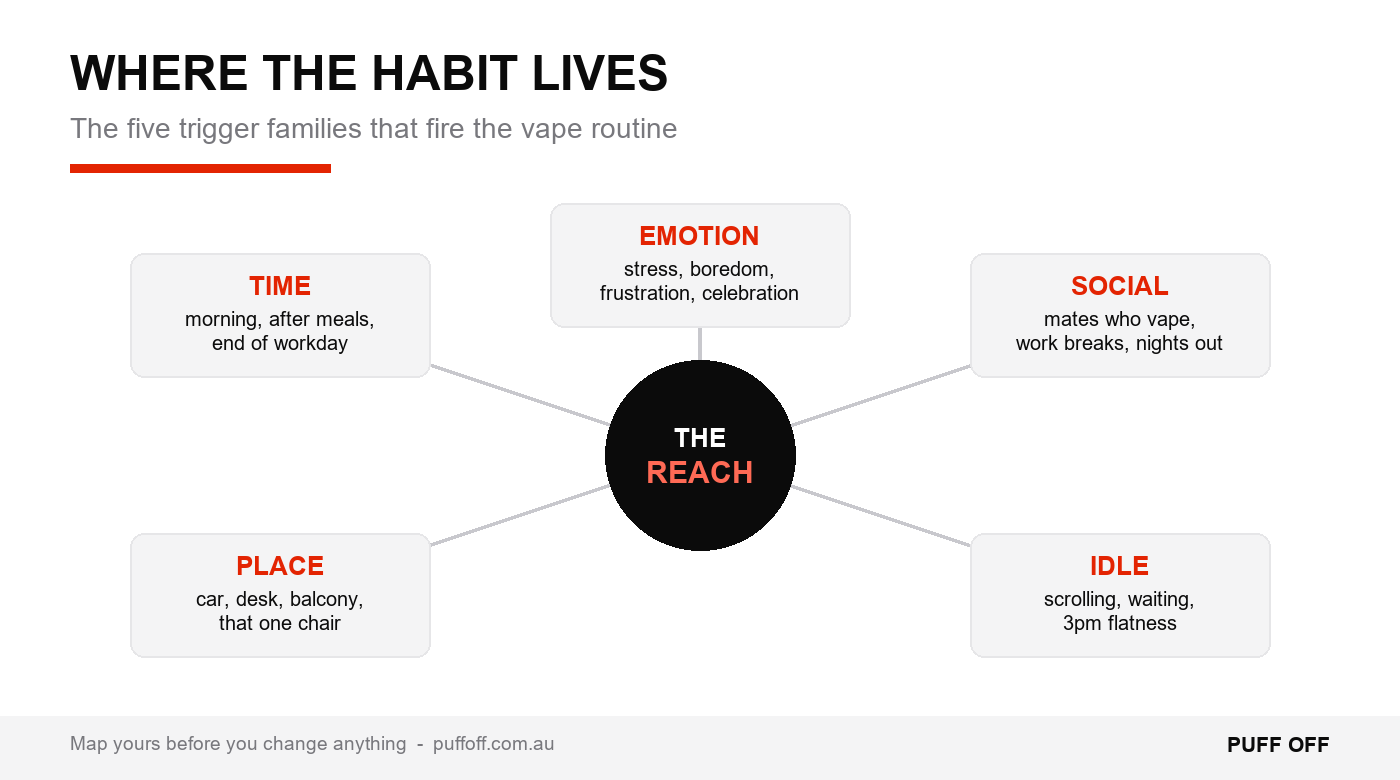
Keep a rough note on your phone each time, with two things: where you were and what you were feeling. After a few days, patterns appear fast. Most people find their triggers cluster into a handful of categories:
- Time-based: first thing in the morning, after meals, the end of the workday, just before bed.
- Place-based: the car, your desk, the balcony, a particular chair.
- Emotional: stress, frustration, boredom, restlessness, even celebration.
- Social: mates who vape, work breaks, parties, stepping outside with someone.
- Idle: scrolling your phone, waiting for something, that flat mid-afternoon lull.
This repetition feels discouraging, but it’s genuinely good news. A pattern that repeats is a pattern you can predict - and anything you can predict, you can plan around. You can’t interrupt a habit you’ve never actually looked at.
Step two: interrupt the loop, one trigger at a time
Here’s where most people overreach. They try to dismantle every trigger at once, run out of energy by Wednesday, and call the whole thing a failure. A far more durable approach is to pick one trigger and work on only that until it stops feeling automatic - then move to the next.
Say your first vape of the day is tied to your morning coffee. For one week, that’s your entire focus. You might:
- delay it by twenty minutes, then thirty, so the coffee and the vape stop arriving together
- change the scene - drink the coffee in a different room or take it for a short walk
- give your hands a competing job - phone in another room, a glass of water first
- keep a nicotine-free alternative within reach for the moment the urge spikes
You’re not trying to be perfect. You’re teaching your brain that coffee doesn’t have to mean vape. Once that link weakens, you take what you learned and point it at the next trigger - the drive, the work break, the evening wind-down.
How long does that take? University College London research by Phillippa Lally tracked 96 people building new routines and found automaticity took 66 days on average, with a range of 18 to 254 days depending on the person and the habit. The same study found that missing a single day made no measurable difference to the outcome. Translation: give each trigger weeks, not days, and don’t treat one slip as a reset.
Small, repeated changes tend to beat big declarations:
- delay the first session of the day
- change what happens around your coffee or commute
- stand up and move the moment stress hits
- keep your hands busy with something else
- swap one familiar moment at a time, not all of them
Step three: replace the routine, don’t just delete it
When you remove a habit and leave a hole, your brain goes looking for a stand-in. That’s why so many people who quit suddenly find themselves snacking constantly, scrolling more, or back to “just one.” The loop still wants to run; it just grabs whatever’s nearest.
Replacing the routine works better than ripping it out. The replacement that fits best is usually whatever scratches the specific itch you miss - and often that’s not the nicotine at all. It’s the hand-to-mouth movement, the inhale and exhale, the small ritual of stepping away for a minute. (We’ve honestly ranked the common options in better alternatives to the vape routine.)
This is the thinking behind Puff Off: nicotine-free, flavour-focused, and built to keep that familiar routine while the automatic pull fades over time. Not through pressure or shame - just by giving the loop a less harmful path to follow while you rebuild your days. For some people that bridge is the difference between a change that survives a bad week and one that doesn’t.
What to do when you slip
You will have an off day. Almost everyone does. The single most important skill in breaking a vape routine isn’t avoiding every slip - it’s refusing to let one slip become a spiral.
The trap is the all-or-nothing thought: “I already caved, so the day’s ruined, might as well.” That one sentence has undone more attempts than any craving. A slip is a single data point, not a verdict. Notice what triggered it (tired? stressed? caught off guard socially?), file it away as useful information, and pick the routine back up at the very next opportunity - not next Monday.
Progress in this kind of change is almost never a straight line. It’s a downward trend with bumps. The people who get there aren’t the ones who never stumble; they’re the ones who keep adjusting after they do. It also helps to know what the first few weeks actually feel like so the bumps don’t catch you by surprise.
Handling social and high-stress moments
Two situations break more attempts than any other: nights out and stress spikes. Both are worth planning for before you’re in them, because that’s not the moment to be improvising.
For social settings, decide your line in advance so you’re not negotiating on the spot: a simple “I’m good, I’ve got my own thing” is usually enough, and having something to do with your hands takes the awkwardness out of it. For stress, the urge is really a request for a fast reset - so give yourself a different one ready to go: a short walk, a few slow breaths, a glass of water, stepping outside without the device. The point isn’t to white-knuckle through. It’s to have a pre-loaded answer so your brain doesn’t default to the old one.
A simple way to begin today
You don’t need a perfect plan or a clear calendar. You need a start - and if you would rather follow a checklist, our first steps to breaking the vape habit guide lays out the same beginning:
- Spend a few days noticing your triggers - no pressure to quit yet.
- Pick the single trigger that fires most often.
- Change the routine around it, and repeat that for a week.
- When it feels less automatic, move to the next trigger.
- Expect bumps, and just keep adjusting after them.
Most people who move past vaping didn’t do it flawlessly. They did it gradually, one loop at a time, until the routine stopped running the show. That’s usually where real change quietly begins.
FAQ
How long does it take to break a vape habit?
There’s no fixed number - it depends on how many routines vaping is tied to and how consistent you are. Many people find the strongest physical urges ease within the first week or two, while the habit side (the automatic reaching) takes longer to fully unwind. Thinking in terms of steady interruption rather than a deadline tends to work better.
Is it better to quit cold turkey or gradually?
Cold turkey works for some people, but if you’ve tried it before and it didn’t stick, that’s useful information. A gradual, one-trigger-at-a-time approach is usually more sustainable because it doesn’t rely on willpower staying high every single day.
Why do I keep relapsing even when I want to stop?
Relapse usually means the underlying routine was never replaced - the cues that set off the habit are still there. Wanting to stop isn’t the same as having a plan for the specific moments (stress, boredom, the car) when the urge shows up. Mapping those moments and preparing a response for each one makes a big difference.
What can I do with my hands instead of vaping?
Anything that occupies the same hand-to-mouth space helps: a glass of water, a short walk, a stress object, or a nicotine-free ritual replacement designed to keep the familiar motion. The aim is to give the loop a different, less harmful path rather than leaving an empty gap.
Does one slip-up mean I’ve failed?
No. A single slip is one data point, not a reset to zero. What matters is how quickly you pick the routine back up afterwards. People who succeed treat slips as information about their triggers, not as proof they can’t do it.
Ready to start? Try the Puff Off Starter Kit
You’ve got the plan - now give the routine something to land on.
The Puff Off Starter Kit is built to keep the routine you’re working to change - nicotine-free, flavour-focused, and easy to keep in your pocket for the moments that test you.
Get the Starter Kit - $12930-day money-back guarantee - if it's not for you, you're covered.