


The Hand-to-Mouth Habit: Why It Outlasts Cigarettes and Vapes
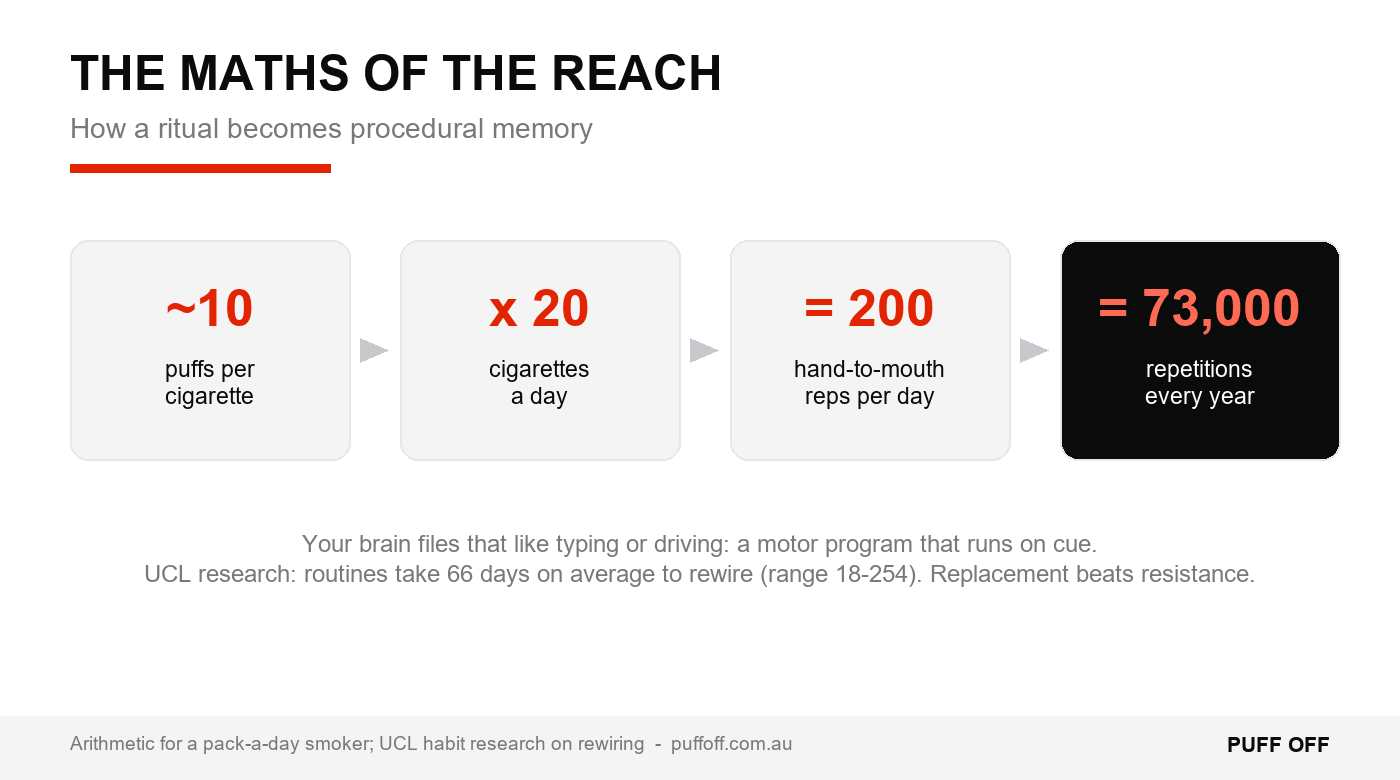
Ask anyone who has stopped smoking or vaping what surprised them most and you will hear the same answer: the nicotine faded, but the hand kept reaching. The hand-to-mouth habit is its own thing, separate from the chemistry, and it is usually the last part to let go. A pack-a-day smoker rehearses the motion roughly 200 times a day. A frequent vaper often rehearses it even more, because a vape never burns down and never says "done." Multiply that by years and you get a movement your body knows better than your signature.
This article is about that movement: why it forms, why it outlasts the substance, and what actually retrains it.
Key takeaways
- The hand-to-mouth motion is rehearsed ~200 times a day by a pack-a-day smoker, often more by vapers
- It survives the nicotine because it is stored as motor habit, not chemical need
- UCL research: routines take 66 days on average to rewire, range 18 to 254 days
- The fix is replacement, not resistance: give the motion somewhere to land
Why the hand keeps reaching after the nicotine is gone
Your brain stores frequently repeated movements as procedural memory, the same system that holds typing, driving and tying shoelaces. You do not think your way through those; your body runs them when the situation calls. Decades of smoking or years of vaping file the reach-inhale-exhale sequence in exactly that drawer.
Nicotine replacement, medication or tapering can settle the chemical side, and for many people that work belongs with a GP or pharmacist. But none of it touches procedural memory. The 3pm slump still cues the reach. The phone call still wants a prop. The after-dinner pause still feels like it is missing a step. That is not weakness or "psychological addiction" in any mysterious sense. It is a well-practised motor program waiting for its cue.
The oral fixation question
People sometimes call this an oral fixation, and the label half fits. The mouth is part of it: the draw, the exhale, the something-between-the-lips. But watch what people actually do when they quit and the hands give it away - pens get clicked, snacks get grazed, phones get gripped. The habit is a whole-body sequence: hand rises, mouth engages, breath changes, brief pause, reset. Any replacement that only serves the mouth (gum, mints) or only the hands (stress balls) covers half the loop, which is why they often feel like they are missing something.
The replacements people stick with tend to honour the full sequence. That is the design logic behind a nicotine-free flavoured air inhaler like Puff Off: the hand rises, the draw happens, flavour lands, the breath resets. Same choreography, nothing burned, nothing emitted, no nicotine keeping the old chemistry alive.
How long does the hand-to-mouth habit take to fade?
University College London research by Phillippa Lally tracked people building routines and found automaticity took 66 days on average, with a range of 18 to 254 days. Unwinding runs on a similar clock, and the same study offers the most reassuring finding in habit science: missing a single day made no measurable difference to the outcome.
In practice, the fade is not linear. The reach fires constantly in week one, gets patchy by week three, then ambushes you occasionally for months: a stressful call, a smell, a mate lighting up. Each time the motion runs into a replacement instead of a vacuum, the old program loses a little authority. Each time it runs into nothing, it stays hungry.
Retraining it, practically
- Map the reach. A day of honest counting tells you which moments own the motion.
- Load a replacement within arm's reach. The window between cue and action is seconds. Whatever answers the reach has to already be in your pocket: water bottle, or a ritual replacement that honours the full hand-mouth-breath sequence.
- One trigger at a time. Retrain the coffee reach for a week before touching the drive reach. Small and sequential beats dramatic and simultaneous, every time.
- Expect the long tail. The 66-day average means some reaches outlive your motivation. Keep the replacement around even after you think you are done. Pride is not a strategy.
The deeper mechanics of the loop - cue, routine, reward - are unpacked in why vape habits feel so hard to break, and the trigger-by-trigger method lives in how to break the vape routine. If your reach was built by cigarettes rather than a vape, the Australian quit-smoking guide covers the support system side.
The reframe that helps most
Stop treating the reach as the enemy. It is not a craving for a substance; it is a request for a ritual. Requests can be answered. People who win this fight almost never delete the hand-to-mouth habit - they redirect it somewhere that costs them nothing. The motion was never the problem. What was on the end of it was.
FAQ
What is the hand-to-mouth habit?
It is the physical ritual of smoking or vaping - hand rises, mouth engages, breath changes - stored by the brain as procedural memory after thousands of repetitions. It operates separately from nicotine dependence, which is why it usually persists after the chemical cravings settle.
Why do I still reach for a cigarette or vape that is not there?
Because the movement is stored like typing or driving: your body runs it automatically when a familiar cue appears (coffee, stress, the car). It is a motor program, not a chemical need, and it fades through replacement and repetition rather than willpower.
How long does the hand-to-mouth habit last after quitting?
UCL habit research suggests routines take about 66 days on average to rewire, with wide individual variation (18 to 254 days). Expect the reach to be constant in week one, patchy by week three, and occasional for months, especially under stress. Each time it meets a replacement instead of a vacuum, it weakens.
Does gum or snacking fix the hand-to-mouth habit?
Partially. Gum and mints serve the mouth but not the hand-rise-and-draw sequence, which is why they often feel incomplete. Replacements that honour the full choreography - hand, mouth, breath - tend to satisfy the moment better and get kept longer.
Is a nicotine-free inhaler good for the hand-to-mouth habit?
That is precisely what it is designed for: the same hand-rise, draw and flavour, with no nicotine, smoke or vapour, so the ritual gets an answer without the old chemistry. It is a habit tool rather than a therapeutic product - for nicotine dependence itself, talk to your GP or pharmacist.
Ready to start? Try the Puff Off Starter Kit
The reach is going to happen. Decide what it finds.
The Puff Off Starter Kit keeps the full hand-to-mouth ritual - nicotine-free, flavour-focused, no batteries, and easy to keep in your pocket for the moments that test you.
Get the Starter Kit - $12930-day money-back guarantee - if it's not for you, you're covered.