


Why Vape Habits Feel So Hard to Break
It’s easy to assume vaping is only about nicotine. If that were the whole story, quitting would feel like giving up nicotine gum - annoying, but not personal. For most people, vaping becomes something much bigger and stranger than that. It quietly threads itself through the ordinary moments of a day until it stops feeling like a choice at all.
The morning coffee. The drive. The work break. Ten minutes of scrolling. The stressful afternoon. The flat, bored evening. At some point the device stops being something you decide to use and becomes something that simply happens - like reaching for your phone the instant you feel a lull. That’s why changing it feels harder than it logically should. You’re not only changing what you use. You’re changing when, where, and why your brain has learned to expect it.
Understanding that machinery isn’t just interesting - it’s the thing that lets you stop blaming yourself and start working on the parts that actually move.
The numbers show how fast this grabbed hold in Australia. Current vaping nearly tripled from 2.5% of people aged 14+ in 2019 to 7.0% in 2022-23, according to the Australian Institute of Health and Welfare, and daily use among 18 to 24 year olds hit 9.3%. Nothing triples in four years unless it’s exceptionally good at building habits.
Key takeaways
- Vaping runs on a cue - routine - reward loop, rehearsed dozens of times a day
- Australian vaping nearly tripled from 2.5% to 7.0% between 2019 and 2022-23 (AIHW)
- Ask of every craving: chemical, or choreography? They need different tools
- Automatic habits are not a willpower problem - they are how every brain works
It’s a loop, not a character flaw
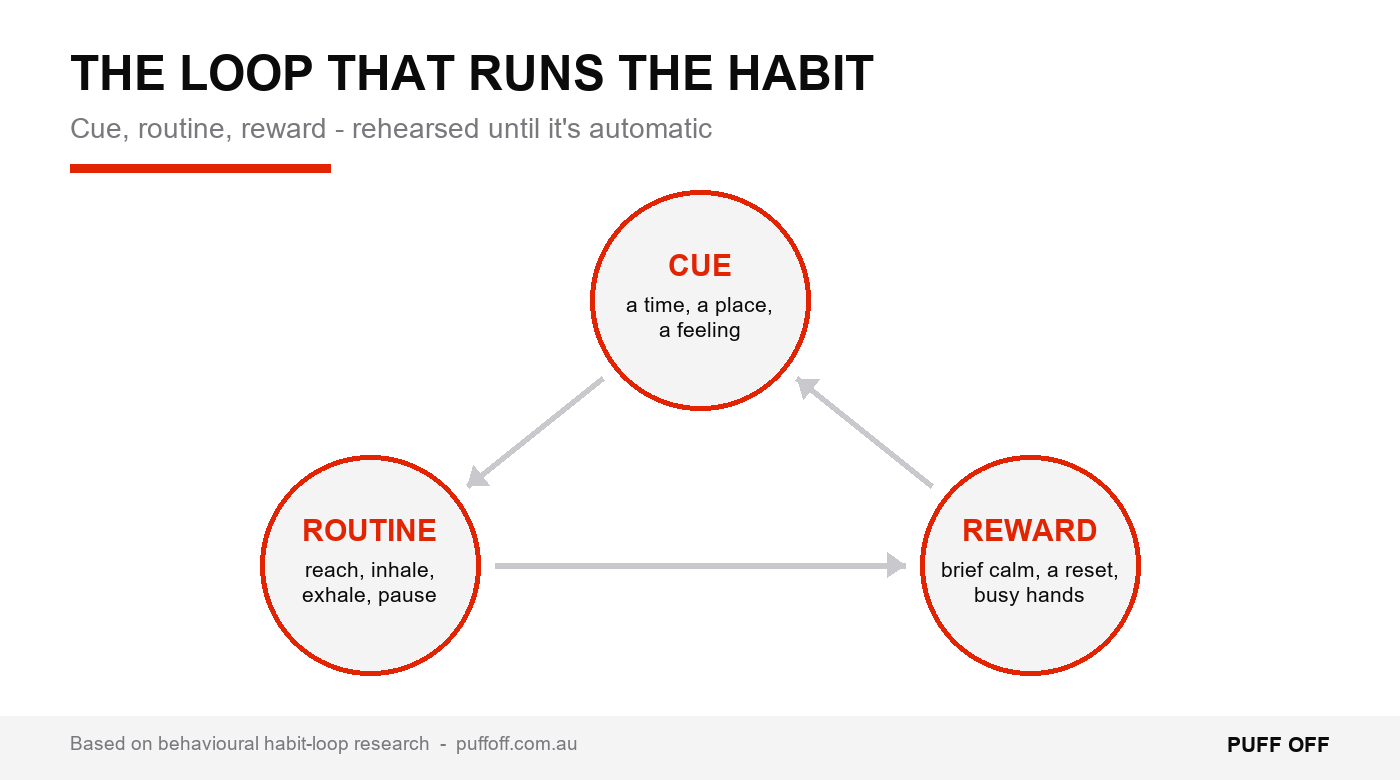
Underneath almost every stubborn habit is a simple three-part loop: a cue, a routine, and a reward.
The cue is the trigger - a time, a place, a feeling. The routine is the behaviour - reaching for the vape, the inhale, the exhale. The reward is the payoff your brain logs - a small hit of calm, a pause, something to do with your hands. Run that loop enough times and your brain starts to automate it. It stops asking whether you want to; it just fires the routine the moment the cue appears.
You finish eating, you reach for it. You hit traffic, you reach for it. A wave of stress, and your hand is already moving. Over time those moments get welded to comfort, to little breaks, to quick mental resets. That’s not weakness - it’s exactly what brains are built to do. We are pattern-running machines, and a habit is just a pattern that got rehearsed often enough to go automatic.
Which is also why leaning purely on “discipline” is exhausting. Discipline asks the conscious, effortful part of your mind to override a loop that now runs on autopilot - every hour, all day. You can win that fight for a while, but it burns energy fast, and it tends to collapse on the days you have the least to spare.
Why vaping wires in so deeply
Plenty of habits form this way. Vaping just happens to be unusually good at it, for a few specific reasons.
It’s constant. A cigarette has a natural endpoint - it burns down and it’s over. A vape doesn’t. You can take a single puff or fifty, in tiny doses, all day long. That means far more repetitions of the loop, and more repetitions mean a deeper groove.
It’s frictionless and discreet. It’s easy to use almost anywhere, easy to do without anyone noticing, easy to slip into the smallest gap in your day. Low friction means the habit attaches to more moments than a more obvious one ever could.
It delivers micro-rewards. Every puff is a tiny “completed” signal - a small, on-demand reset. Stack dozens of those across a day and your nervous system quietly starts using them as a way to regulate stress and boredom. When you try to stop, you’re not only losing a substance; you’re losing a tool your brain had been leaning on constantly.
It carries flavour and identity. Flavour adds a layer of reward and personal preference that plain habits lack, and for some people the device becomes part of how they see themselves. That makes the loop feel less like a behaviour and more like a part of you - which is harder to put down.
Your environment is louder than you think
Triggers aren’t only internal feelings. They’re physical and contextual, and they work below the level of conscious thought. The same desk. The same drive. A particular chair. A friend’s device on a table. Even a specific flavour or smell can set the routine in motion before you’ve consciously decided anything.
This is why people are often blindsided by how many little moments turn out to be connected to vaping. You don’t notice the web until you try to step out of it and feel the pull from a dozen directions at once. None of that means something is wrong with you. It means the habit has been repeated in enough contexts that the contexts themselves now act as cues. Change the context and you weaken the cue; keep it identical and your brain keeps running the old program.
Separate the physical from the behavioural
Here’s one of the most useful distinctions you can make, because it tells you what to actually replace. When a craving hits, ask yourself a simple question: is this chemical, or is this routine?
Sometimes it’s genuinely the nicotine talking. But very often what people miss most is the behaviour:
- the hand-to-mouth movement
- the inhale and exhale rhythm
- the pause during a stressful moment
- the feeling of stepping away and “taking a break”
If a lot of your pull is behavioural, then trying to fix it with chemistry alone (or with pure willpower) will always feel like it’s missing the point - because it is. The behavioural side needs a behavioural answer: replacing the routine rather than just deleting it.
That’s why gradual replacement tends to outperform sudden removal. Small changes, repeated, quietly loosen the loop:
- delay the first vape of the day
- change one trigger at a time
- keep your hands occupied during the gaps
- swap your routine during stress for a different reset
- replace familiar patterns with something less disruptive
Each of those is a small vote against the automatic loop. Cast enough of them and the pattern stops running itself. For the practical version of this - one trigger at a time - see how to break the vape routine.
A gentler, more realistic way forward
This is also the idea behind Puff Off - nicotine-free, flavour-focused, and built to keep the familiar routine while you move past the habit gradually. Not through guilt or pressure, but by giving the behavioural loop a less harmful path to follow while the automatic pull fades. For people whose struggle is mostly the routine, that bridge can make the difference between a change that holds and one that doesn’t.
Because here’s the thing most people get wrong: they think they need more shame, more grit, more proof that they’re strong enough. They don’t. The habit isn’t strong because you’re weak. It’s strong because it’s been rehearsed thousands of times in dozens of contexts, and that’s simply how repetition works.
What actually helps is awareness first. Once you can see the loop clearly - the cues that set it off, the rewards it’s really delivering, the moments it owns - it stops feeling like a mysterious force and starts looking like what it is: a pattern. And patterns, unlike character flaws, can be changed.
If you’re ready to act on that, start with first steps to breaking the vape habit - and if fear of the adjustment is what’s holding you back, here’s what the first few weeks actually feel like. It’s usually less dramatic than the internet suggests.
FAQ
Is vaping addictive because of nicotine or habit?
For most people it’s both, in different ratios. Nicotine creates a chemical pull, but the habit - the routine, the hand-to-mouth movement, the stress reset - wires itself just as deeply through repetition. That behavioural side is often what people underestimate, and it’s a big reason quitting feels harder than expected.
Why does vaping feel harder to quit than smoking for some people?
Vaping tends to be more constant, more discreet, and easier to do in tiny doses throughout the day than smoking. More repetitions create a deeper habit loop, and flavours add another layer of reward. None of that means you’re failing - it means the habit has simply been reinforced more often.
Why do I vape without even thinking about it?
Because the behaviour has become automatic. Once a cue (a time, a place, a feeling) is linked to the routine enough times, your brain fires it without conscious input - the same way you reach for your phone in a quiet moment. Noticing those cues is the first step to interrupting them.
Does that mean I have no self-control?
No. Automatic habits aren’t a measure of willpower - they’re how every human brain handles repeated behaviour. Relying on discipline alone is hard precisely because you’re trying to consciously override an automated loop all day. Changing the cues and replacing the routine works with your brain instead of against it.
What actually helps loosen the habit?
Awareness first - seeing your specific cues and rewards clearly - followed by small, repeated changes: delaying sessions, changing one trigger at a time, keeping your hands busy, and replacing the routine rather than just removing it. Consistent small interruptions weaken the automatic loop over time.
Ready to start? Try the Puff Off Starter Kit
Once you can see the loop, the next step is giving it a less harmful path to follow.
The Puff Off Starter Kit is built to keep the routine you’re working to change - nicotine-free, flavour-focused, and easy to keep in your pocket for the moments that test you.
Get the Starter Kit - $12930-day money-back guarantee - if it's not for you, you're covered.