


Better Alternatives to the Vape Routine (That People Actually Stick With)
The most common mistake people make when they try to move past vaping is removing it without putting anything in its place. It usually holds for about a day - maybe two - and then the old routine slides right back in. People tend to read that as a discipline problem. It isn’t. It’s that habits don’t leave quietly, and a gap with nothing in it is an open invitation for the old loop to return. (We’ve explained why the habit wires in so deeply if you want the mechanics.)
If you want an alternative that actually sticks, it helps to understand what you’re really replacing. Most people assume it’s the nicotine. For a lot of vapers, though, the nicotine is only part of the pull - and often the smaller part.
The scale of the problem is real: about 3.5% of Australians vape daily, roughly 700,000 people, according to the Australian Institute of Health and Welfare’s National Drug Strategy Household Survey 2022-23. That’s 700,000 people running the same hand-to-mouth loop dozens of times a day - which is exactly why replacements that ignore the loop keep failing.
Key takeaways
- You are replacing five things at once: routine, pause, hand-to-mouth, breath rhythm, reset
- A real alternative must be available, low-effort and satisfying in your worst moments
- Single tools fail; a small stack (environment + hands + ritual replacement) holds
- Give any replacement a two-week fair run before judging it
What you’re actually replacing
Sit with the moment you reach for a vape and you’ll usually find it’s wrapped in several things at once:
- the routine itself - a familiar sequence your day is built around
- the pause - a sanctioned little break from whatever you’re doing
- the hand-to-mouth movement - a physical action your hands have memorised
- the inhale and exhale rhythm - something closer to a breathing pattern than a craving
- the reset - a quick way to shift state when you’re stressed, bored, or overstimulated
When you tell yourself “I’ll just stop,” you’re not removing one thing. You’re removing all of those at once, with nothing to catch the moments they used to fill. No wonder it feels harder than it sounded. The fix is to find replacements that cover the parts you actually miss - and that you’ll realistically reach for on a bad day, not just a motivated one.
The honest test for any alternative
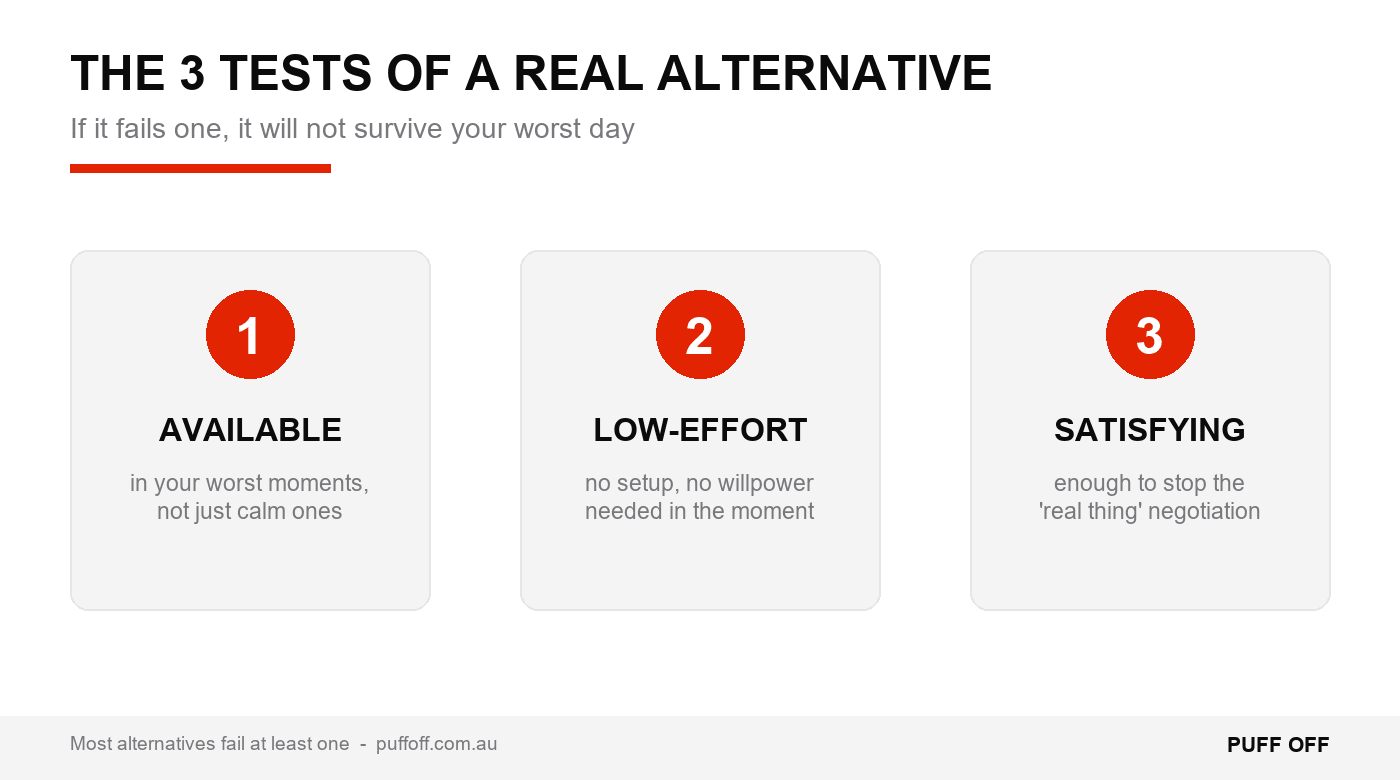
Before we run through the options, here’s the filter that matters most. A good replacement has to be:
- Available in your worst moments. If it only works when you’re calm and organised, it won’t survive the stressful afternoon when you need it most.
- Low-effort to use. Anything that takes setup or willpower in the moment loses to the device that’s already in your pocket.
- Satisfying enough to stop the negotiation. If it leaves you feeling cheated, your brain will keep lobbying for “the real thing.”
Most alternatives fail one of those three tests. The ones people actually stick with pass all three.
A realistic rundown of the options
Movement (walking, stretching, stepping outside)
Moving your body is one of the best ways to discharge a stress spike, and a short walk doubles as a change of scene that breaks the trigger. The catch: it isn’t always available. You can’t walk out of a meeting or a long drive. Treat movement as a powerful support rather than your only tool - brilliant for the moments it fits, useless for the ones it doesn’t.
Keeping your hands and mouth busy
A glass of water, gum, a toothpick, a stress object, sunflower seeds - anything that occupies the same physical space the habit used to. These are cheap and genuinely help with the hand-to-mouth side. On their own they often feel like they’re missing something, because they don’t replicate the inhale or the ritual, but stacked with other changes they take real pressure off.
Reducing exposure to triggers
Sometimes the most effective “alternative” is changing the environment so the cue never fires. Don’t keep the device on your desk or in the cup holder. Take a different route. Sit in a different chair. You’re not relying on willpower in the moment - you’re removing the moment. This works best in combination with a replacement for the times you can’t avoid the trigger. For a one-trigger-at-a-time method, see how to break the vape routine.
Distraction techniques
Phone games, breathing exercises, a quick task - they buy time while a craving wave passes, and waves do pass. The risk is swapping one autopilot loop for another (endless scrolling is its own trap), so use distraction as a bridge through a spike, not as a lifestyle.
Nicotine-free ritual replacements
For people whose pull is mostly the routine - the hand movement, the inhale, the flavour, the familiar break - a nicotine-free option that keeps that shape tends to pass all three tests above. It’s available, it’s effortless, and because it preserves the ritual, it actually satisfies the moment instead of leaving a gap.
This is where Puff Off fits for some people: nicotine-free, flavour-focused, and built to keep the familiar routine while you move away from the nicotine side of it. It isn’t a magic fix and it isn’t for everyone - but if the routine is the hard part, a like-for-like replacement is usually more durable than trying to white-knuckle the gap.
Why most alternatives fail (and how to avoid it)
The single biggest reason alternatives don’t stick is that they target one layer while the habit is built from several. A nicotine patch addresses chemistry but leaves the hand-to-mouth ritual untouched. A walk handles stress but not boredom at your desk. Gum covers the mouth but not the “I need a break” feeling.
Vaping, for most people, is chemistry plus routine plus stress relief plus boredom plus identity, all bundled together. So the alternatives that work aren’t single heroes - they’re usually a small stack: change the environment, keep your hands busy, and have one reliable ritual replacement for the moments that really test you.
The other quiet failure mode is perfectionism. People expect an alternative to feel as good as the habit on day one, and when it doesn’t, they bin it. Give a replacement a fair run - a week or two - before you judge it. Your brain is comparing it to a deeply grooved routine; it needs a little repetition before the new option feels normal.
How to choose yours, in three questions
- When do I fail first? Build your plan around your hardest hour - the after-dinner slump, the commute, the late-night scroll - not your easiest one.
- Is my pull mostly nicotine, mostly routine, or both? Routine-heavy points you toward a ritual replacement plus trigger changes. If nicotine feels like the bigger driver, factor that into your pace and consider professional advice.
- Will I actually carry it? The most effective alternative in the world does nothing from a drawer. Pick something you’ll genuinely keep on you.
You don’t need seventeen tools and a new personality. You need one reliable replacement for the ritual, a couple of environment tweaks, and the patience to let small, consistent changes do their work. That combination outlasts dramatic promises almost every time. When you’re ready to structure it week by week, follow the realistic step-by-step plan.
FAQ
What’s the best alternative to vaping?
There isn’t one universal answer - the best alternative is the one that covers the part you miss most and that you’ll actually use under stress. For routine-driven habits, a nicotine-free ritual replacement plus a few environment changes tends to work better than any single tool on its own.
Do nicotine-free options actually help?
For people whose habit is mostly about the routine - the hand-to-mouth motion, the inhale, the flavour, the break - a nicotine-free replacement can take real pressure off the behavioural side while you move away from nicotine. It’s most effective combined with trigger changes rather than used in isolation.
Why do I always go back to vaping after a few days?
Usually because the alternative didn’t cover all the layers, or it only worked while your motivation was high. If a replacement fails on your hardest day, it won’t last. Choose something available and effortless in your worst moments, and give it a week or two before deciding it doesn’t work.
Can I just use willpower instead of a replacement?
You can try, but willpower is strongest when you’re calm and weakest exactly when your triggers spike - which is backwards from what you need. Most people find that having a concrete replacement and a couple of environment changes is far more reliable than relying on willpower alone.
How many alternatives should I use at once?
A small stack usually beats a single tool: one environment change (keep the device out of reach), one hands-busy option, and one ritual replacement for the moments you can’t avoid. Trying to juggle too many at once tends to fizzle, so start with two or three you’ll genuinely keep up.
Ready to start? Try the Puff Off Starter Kit
If you’d rather have one reliable replacement than a drawer full of half-tries, this is a simple place to start.
The Puff Off Starter Kit is built to keep the routine you’re working to change - nicotine-free, flavour-focused, and easy to keep in your pocket for the moments that test you.
Get the Starter Kit - $12930-day money-back guarantee - if it's not for you, you're covered.