


Quitting Vaping in Australia: Rules, Options and What Actually Helps (2026 Guide)
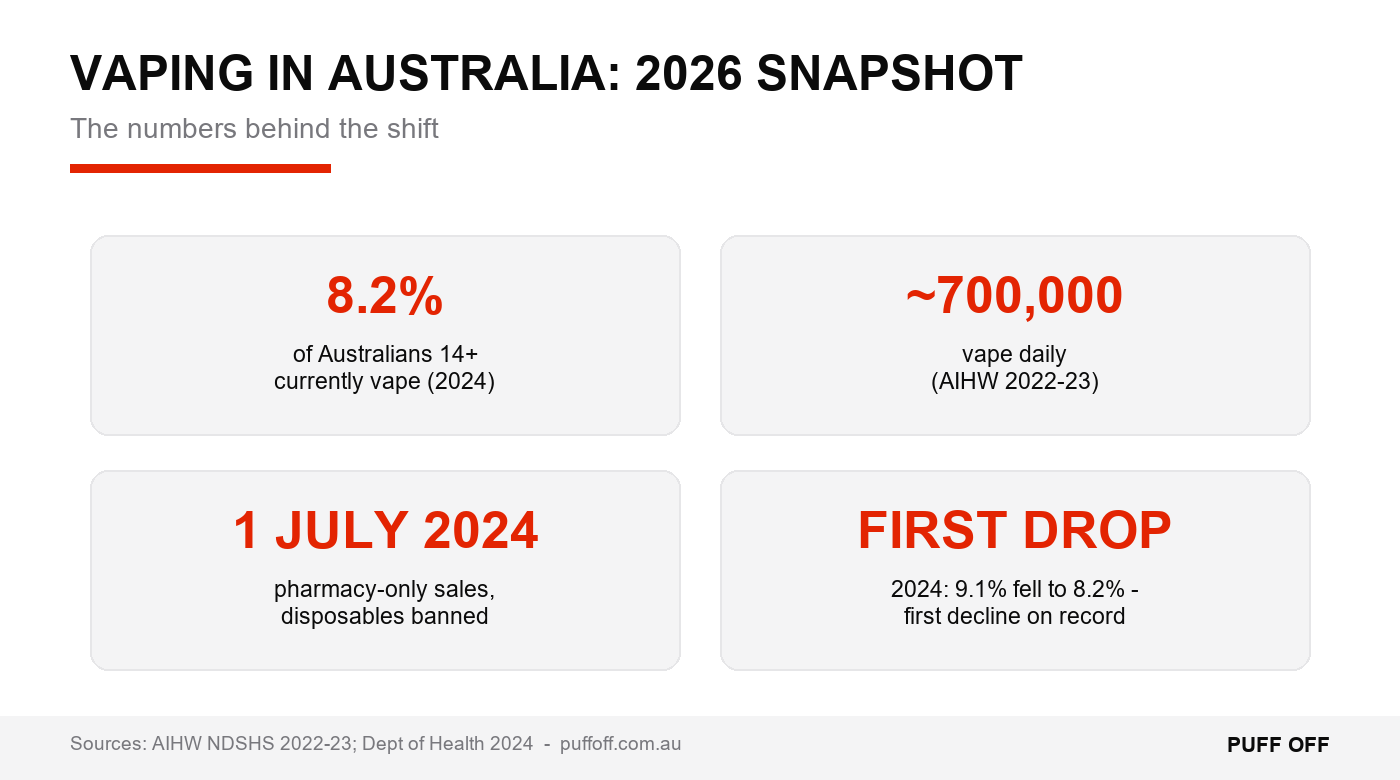
Quitting vaping in Australia looks different from almost anywhere else in the world, because since 1 July 2024 vapes can only legally be sold through pharmacies - and that changes both how people vape and how they stop. Around 8.2% of Australians aged 14 and over currently vape according to Department of Health data, and 2024 was the first year on record that number fell. If you’re thinking about stepping away from it, this guide covers the rules, the support options, and the part most advice skips: the habit itself.
One thing before we start: this is general information, not medical advice. If you’re managing nicotine dependence, your GP or pharmacist is the right first stop.
Key takeaways
- Since 1 July 2024 vapes are pharmacy-only in Australia; disposables are banned
- About 8.2% of Australians 14+ currently vape; ~700,000 daily (AIHW)
- 2024 saw the first decline on record - the tide is turning
- Free support exists: Quitline 13 7848 and the My QuitBuddy app
What are the vaping rules in Australia right now?
Since 1 July 2024, all vapes and vaping products - including nicotine-free ones - can only be sold in pharmacies, for the purpose of helping people quit smoking or manage nicotine dependence. Disposable vapes are banned from import and sale. Vape shops and convenience stores can no longer legally sell them.
In practice, that changed the daily experience of vaping for a lot of Australians. The corner-store supply is gone, prices moved, and the products themselves became more regulated. For plenty of people, the new friction became the push they’d been waiting for: when the habit stops being effortless, stopping starts feeling possible.
How many Australians vape - and how many are stopping?
The Australian Institute of Health and Welfare’s National Drug Strategy Household Survey 2022-23 found that current vaping nearly tripled between 2019 and 2022-23, from 2.5% to 7.0% of people aged 14 and over. Daily use sits around 3.5% - roughly 700,000 Australians. Among 18 to 24 year olds, 9.3% vape daily and about 49% have tried it.
But the trend just turned. National prevalence peaked at 9.1% in 2023 and fell to 8.2% in 2024 - the first recorded decline. That’s hundreds of thousands of Australians moving away from vaping at the same time as you. Whatever you’re feeling about quitting, you’re not doing it alone.
What support options exist in Australia?
There’s no single right way to move away from vaping. These are the main lanes Australians use, and what each one does well:
- Your GP or pharmacist. The frontline option, especially if nicotine dependence is significant. They can talk through nicotine replacement therapy (patches, gum, lozenges) and, where appropriate, structured programs. If you vape heavily and feel physically unwell when you stop, start here.
- Quitline (13 7848). Free, confidential phone counselling. Evidence consistently shows support and accountability improve quit outcomes, and it costs nothing to try.
- The My QuitBuddy app. The Australian Government’s free quit app - tracking, milestones, and distraction tools in your pocket.
- Habit tools. Everything above targets nicotine and motivation. It leaves a gap: the hand-to-mouth ritual you’ve repeated thousands of times. That behavioural layer is where a lot of quit attempts actually break down, and it’s the piece the rest of this article focuses on.
The part most advice misses: the habit layer
Nicotine is only half the story. The other half is the routine - the inhale, the pause, the thing your hands do in the car, after meals, and at your desk. University College London research on habit formation found routines take 66 days on average to become automatic, with a range of 18 to 254 days. A habit you’ve run dozens of times a day for years doesn’t switch off because the pharmacy is further away than the servo was.
That’s why some people white-knuckle the nicotine side successfully and still relapse weeks later in a stressful moment: the loop was still there, waiting for its cue. Whatever quit path you choose, plan for the routine, not just the chemistry:
- map your trigger moments before you change anything
- interrupt one trigger at a time rather than all of them at once (our trigger-by-trigger method walks through exactly how)
- replace the ritual instead of leaving a hole where it was
- treat slips as information, not failure - the UCL study found missing a single day made no measurable difference to habit outcomes
Some adults keep the familiar hand-to-mouth ritual with a nicotine-free option while they work on the routine - a flavoured air inhaler like Puff Off is one example. It contains no nicotine, no smoke, no vapour and no batteries, and it isn’t a vape or a therapeutic product. It’s a habit tool: something for your hands and your breath to do while the automatic pull fades.
A realistic starting sequence
If you want a simple order of operations that respects both layers:
- Talk to your GP or pharmacist if you’re a heavy or long-term vaper - get the nicotine side assessed properly.
- Spend a week noticing your triggers. No pressure to quit yet - this is exactly where our first-steps guide begins. Just watch when your hand moves.
- Pick your nicotine strategy - step down, NRT, or straight to zero - and hold it for at least two weeks before judging it.
- Give the ritual somewhere to land. Water, walks, breathing, a nicotine-free ritual replacement - whatever you’ll actually reach for at 9pm.
- Use free support. Quitline and My QuitBuddy exist for exactly this and cost nothing.
- Expect the 66-day arc. Weeks, not days. Bumps, not straight lines.
FAQ
Is it legal to buy vapes in Australia in 2026?
Vapes can only be legally sold through pharmacies in Australia, a rule in place since 1 July 2024. This covers nicotine and nicotine-free vaping products, and disposable vapes are banned from import and sale. Products that aren’t vapes - like nicotine-free flavoured air inhalers with no battery, heating element or vapour - aren’t part of the pharmacy-only scheme.
How many people vape in Australia?
About 8.2% of Australians aged 14 and over currently vape according to 2024 Department of Health data, with daily use around 3.5% (roughly 700,000 people per the AIHW’s 2022-23 survey). The national rate fell for the first time on record in 2024, down from a 9.1% peak in 2023.
What free quit support does Australia offer?
Quitline (13 7848) provides free confidential counselling, and the Australian Government’s My QuitBuddy app offers free tracking and craving tools. Your GP or pharmacist can also advise on nicotine replacement options. All of these can be combined with your own habit plan.
Why is quitting vaping so hard even with patches or gum?
Nicotine replacement addresses the chemical side but not the behavioural one - the hand-to-mouth ritual, the inhale, the pause your brain expects dozens of times a day. UCL habit research suggests routines take around 66 days on average to rewire, so most people need a plan for the ritual itself, not just the nicotine.
Should I see a doctor before quitting vaping?
If you vape heavily, have been vaping a long time, or have any health conditions, talking to your GP or pharmacist first is sensible - they can assess nicotine dependence properly and discuss support options. This article is general information, not medical advice.
Ready to start? Try the Puff Off Starter Kit
If the habit layer is your hard part, give the ritual somewhere to land.
The Puff Off Starter Kit keeps the hand-to-mouth routine - nicotine-free, flavour-focused, no batteries, and easy to keep in your pocket for the moments that test you.
Get the Starter Kit - $12930-day money-back guarantee - if it's not for you, you're covered.