


Can You Just Quit Vaping? What the Easiest Way Actually Looks Like
Yes, you can just quit vaping - some people put the device down one day and never pick it up again. But for most people, going from constant vaping to nothing on willpower alone doesn't hold, because vaping is two problems wearing one coat: a nicotine dependence and a deeply rehearsed physical habit. The easiest way to quit, for most people, is not the most dramatic one. It's the one that deals with both layers: manage the nicotine side honestly, and replace the hand-to-mouth routine instead of leaving a hole where it used to be.
Here's the full picture, including when cold turkey does work.
Key takeaways
- Cold turkey works best for light vapers with shallow routines
- Most people do better on two tracks: handle the nicotine, replace the ritual
- Cravings pass in minutes - delay beats debate
- The 'fast' method that collapses in week two is slower than the steady one
Can you quit vaping cold turkey?
You can, and some people do. Cold turkey works best when your usage is light, your routine attachments are shallow, and your life is calm enough to absorb a rough week or two.
Where it tends to fall apart is frequency. A vape has no natural endpoint the way a cigarette does - you can take five puffs or fifty, all day long - so the habit gets rehearsed dozens of times daily. By the time you try to stop, you're not breaking one decision. You're breaking a loop that fires automatically in the car, after meals, at your desk and at 9pm on the couch.
That's why the same pattern repeats for so many people: two or three strong days, then one stressful afternoon, then "just one puff," then back to square one feeling like a failure. The failure isn't weakness. It's a plan that only addressed half the problem.
Why "just stopping" is harder than it sounds
The scale of the habit side is easy to underestimate. Around 8.2% of Australians aged 14 and over currently vape according to 2024 Department of Health data, and about 700,000 vape daily per the Australian Institute of Health and Welfare. Daily use means thousands of repetitions a year - and repetition is exactly how habits harden.
University College London research by Phillippa Lally found that routines take 66 days on average to become automatic, with a range of 18 to 254 days. Unwinding an automatic routine follows a similar arc. So a quit plan that expects everything to be settled in a week is fighting the maths, and a plan that runs on willpower alone is spending its scarcest resource on every single trigger, every single day.
So what's the easiest way to quit vaping?
The easiest way, for most people, is a two-track approach that's boring on purpose:
Track 1 - handle the nicotine honestly. Decide whether you're stepping down gradually or going straight to zero, and hold that lane for at least two weeks. If you're a heavy or long-term vaper, talk to your GP or pharmacist about nicotine replacement options. Free support exists too: Quitline (13 7848) and the government's My QuitBuddy app.
Track 2 - replace the ritual, don't delete it. The inhale, the pause, the thing your hands do - that loop needs somewhere to land or it will hunt for its old home. Practical replacements include water, short walks, slow breathing, and keeping your hands occupied. Some adults use a nicotine-free flavoured air inhaler like Puff Off to keep the familiar hand-to-mouth ritual without nicotine, smoke, vapour or batteries - a habit tool for the moments that used to belong to the vape.
Then make the plan small - if you want the beginner version, start with our first steps to breaking the vape habit:
- Spend a few days noticing when you reach for it - no quitting yet, just watching.
- Pick your single most frequent trigger and change only that for a week - our guide on how to break the vape routine covers this trigger by trigger.
- Ride cravings as waves - they spike, crest and fade, usually within minutes. Delay beats debate.
- When a trigger stops feeling automatic, move to the next one.
- Treat slips as data. The UCL study found missing a single day made no measurable difference to whether new routines stuck.
Slower than cold turkey? On paper. But the "fast" method that collapses in week two is slower than the steady one that holds.
Cold turkey vs gradual: an honest comparison
| Approach | Works best when | Watch out for |
|---|---|---|
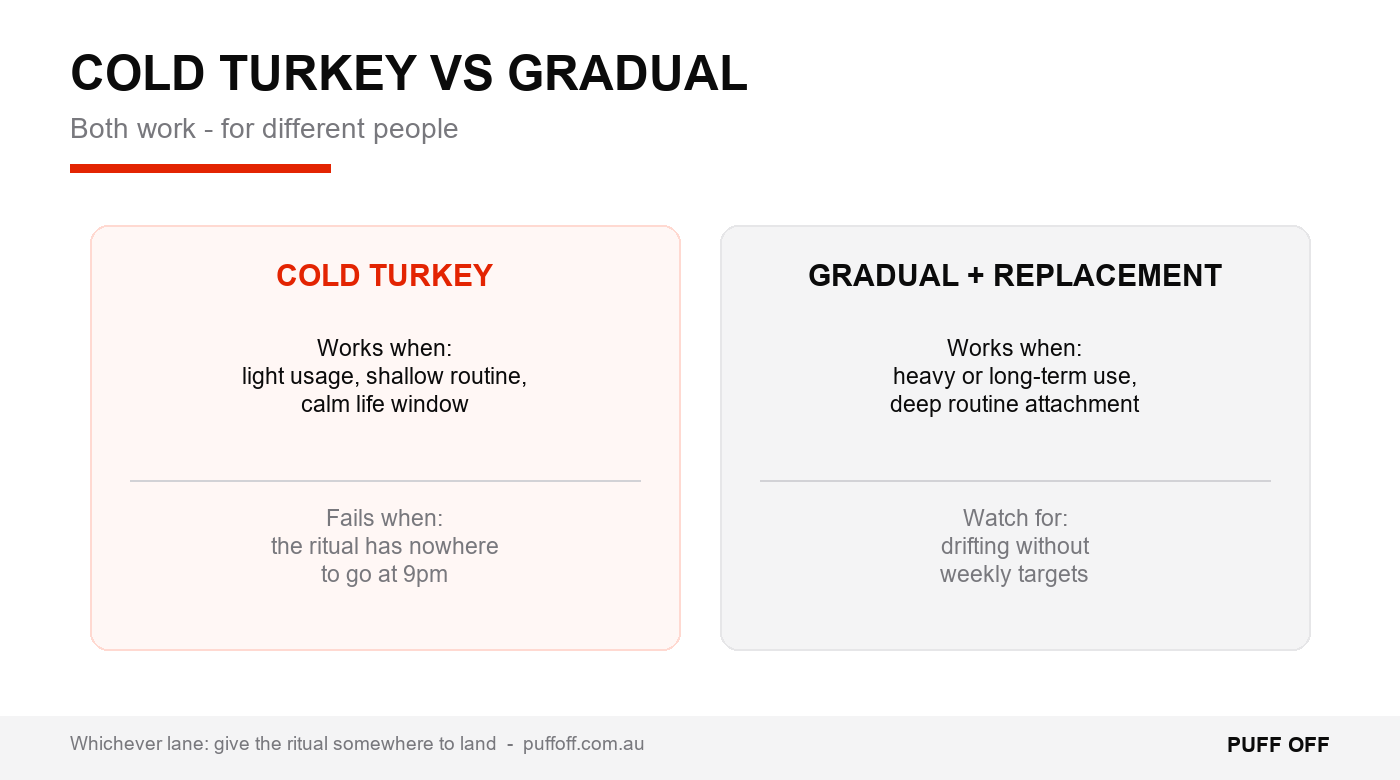
| Cold turkey | Light usage, low routine attachment, calm life window | The 9pm negotiation; stress spikes; leaving the ritual with nowhere to go |
| Gradual reduction | Heavy or long-term use, deep routine attachment | Drifting without targets - set weekly steps or it becomes wallpaper |
| Either + ritual replacement | Almost everyone with a hand-to-mouth habit | Choosing a replacement you won't actually carry |
Whichever lane you pick, the common thread in the attempts that stick is this: the routine gets a plan, not just the nicotine.
The encouraging part
Australia's vaping rate fell for the first time on record in 2024 - from a 9.1% peak in 2023 to 8.2% according to the Department of Health. Behind that number are hundreds of thousands of people working through exactly the process above, imperfectly, one trigger at a time. It's not a question of whether people can move past vaping. They demonstrably are. It's a question of picking an approach that survives your hardest hour, not just your most motivated one.
If you want the full step-by-step version, read our realistic step-by-step plan. If the first weeks are what worry you, here's what they actually feel like. And if you keep bouncing back to the habit no matter what, this explains why - and what loosens it.
General information only, not medical advice. For nicotine dependence, speak to your GP or pharmacist.
FAQ
Can you quit vaping cold turkey?
Yes, and it works for some people - usually lighter vapers with fewer routine attachments and a calm stretch of life to absorb the adjustment. For heavier or long-term vapers, cold turkey often fails not from lack of willpower but because it removes the hand-to-mouth ritual with nothing in its place. If you've tried cold turkey twice and bounced, that's information: try a two-track approach instead.
What is the easiest way to quit vaping?
For most people, the easiest way is handling the nicotine and the habit as separate problems: choose a nicotine strategy (step-down or straight to zero, with GP or pharmacist advice if needed) and replace the hand-to-mouth ritual rather than deleting it. Changing one trigger at a time is consistently more sustainable than fighting every urge at once.
How long does it take to stop wanting to vape?
The sharpest cravings usually ease within the first one to two weeks, but the habit side lingers longer. UCL habit research found routines take 66 days on average to rewire, with wide individual variation - so expect weeks of gradually quieter urges rather than a clean finish line.
What can I do when a craving hits?
Treat it as a wave: it spikes, crests and fades, usually within minutes. Delay for a few minutes before acting, breathe slowly, drink water, occupy your hands, or reach for a nicotine-free replacement. Every wave you outlast weakens the loop slightly.
Is it bad to quit vaping suddenly?
For most healthy adults, stopping suddenly isn't dangerous - the challenge is comfort and sustainability rather than safety. If you vape heavily, have health conditions, or feel unwell when you stop, talk to your GP or pharmacist about a managed approach.
Ready to start? Try the Puff Off Starter Kit
Whichever lane you pick, the ritual needs somewhere to land - this is a simple place to start.
The Puff Off Starter Kit keeps the hand-to-mouth routine - nicotine-free, flavour-focused, no batteries, and easy to keep in your pocket for the moments that test you.
Get the Starter Kit - $12930-day money-back guarantee - if it's not for you, you're covered.