


What the First Few Weeks Without Vaping Actually Feel Like
One of the biggest reasons people put off changing their vaping habit isn’t a lack of motivation. It’s fear of what comes next. You read the online stories - miserable for weeks, snapping at everyone, thinking about it every five minutes - and it’s enough to make you quietly decide you’ll do it “later, when life calms down.”
Here’s the reassuring part: the reality is usually a lot less dramatic than the internet makes it sound. Messy in places? Sometimes. Uncomfortable here and there? Sure. But for most people the hardest part isn’t purely physical - it’s the routine shifting underneath them. Knowing what’s actually coming, and when, takes a surprising amount of the fear out of it.
This is a realistic, week-by-week picture. Everyone’s different, so treat it as a map, not a timetable.
Key takeaways
- The loudest cravings are front-loaded into days 1-3 and come in waves, not walls
- By week 2 you are fighting routine, not nicotine - completely normal
- UCL research: habits take 66 days on average to rewire; one slip changes nothing
- Australian vaping fell for the first time on record in 2024
First, separate the two things you’re dealing with
A lot of people assume they’re only fighting nicotine. In reality you’re managing two overlapping things at once:
- The physical adjustment - your body recalibrating to a different baseline. This tends to be loudest early and fade relatively quickly.
- The behavioural adjustment - your brain missing the routine: the hand-to-mouth movement, the pauses, the resets, the dozens of small autopilot moments. This is usually quieter but lasts longer.
If you only plan for the physical side, the behavioural side is what ambushes you a week or two in and sends you back. Expecting both is half the battle. (New to this? The groundwork in first steps to breaking the vape habit makes the weeks below much easier.)
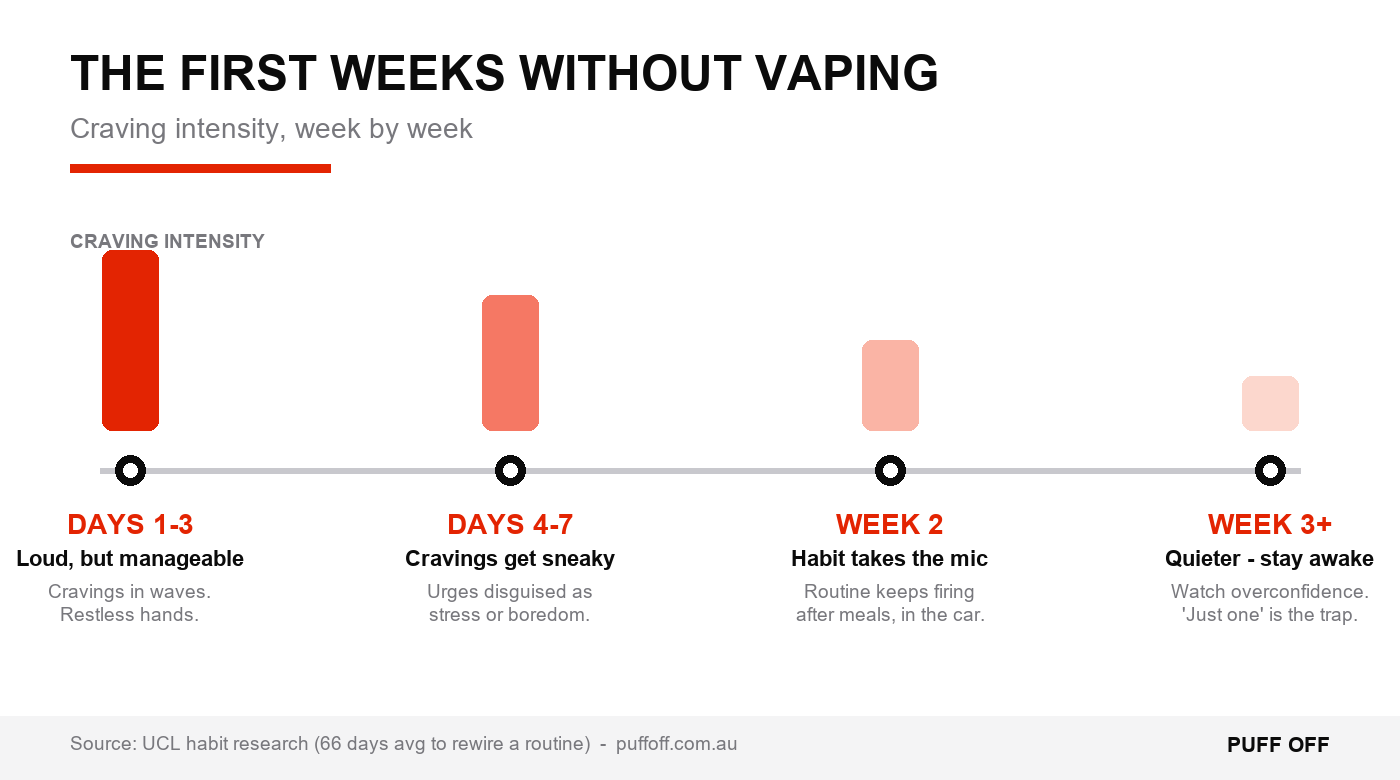
Days 1–3: loud, but manageable
The first few days are usually the most intense - though it’s more like waves than constant chaos. A craving rises, peaks, and passes, rather than sitting on you all day. You might notice:
- stronger urges at particular times of day
- irritability or a shorter fuse than usual
- restless energy, like you don’t quite know what to do with yourself
- brief patches of trouble concentrating
- a nagging “something’s missing” feeling
For most people it shows up most in predictable spots: in the car, after meals, while working, during stress, and late at night. That’s simply when the old routines surface most clearly.
What helps in these first days isn’t heroics - it’s taking the pressure off. Don’t aim for a flawless day; aim to not fold in your single worst moment. Practical, unglamorous things genuinely work here:
- drink more water than feels necessary
- move when the restlessness builds - a short walk resets a lot
- keep your hands busy through the waves
- delay rather than forbid (“I’ll wait ten minutes”) - most urges shrink in that window
Days 4-7: the cravings get sneaky
By the back half of the first week, the sharpest physical edge often starts to dull. In its place comes something subtler: cravings that feel “smarter.” You’re fine all day, then suddenly not fine at 9pm. The urge shows up disguised as stress, or boredom, or a reward you feel you’ve earned.
This is where a pre-decided plan beats willpower. Don’t leave yourself negotiating in the moment - have a set response ready: water, a walk, five slow breaths, or reaching for a ritual replacement. And fix your environment so you’re not relying on resolve: if the device lives on your desk or in the cup holder, that’s not a test of strength, it’s a trap you can simply remove.
Week 2: the “I should be fine by now” trap
Around the second week, many people hit a strange patch. The physical symptoms have mostly quietened, so part of you expects to feel finished - and then a craving arrives anyway, and it’s confusing. You might feel oddly nostalgic for vaping, like missing an ex you didn’t even particularly like.
What’s happening is that the behavioural loop has taken over from the chemical one. You’re not really fighting nicotine anymore; you’re fighting routine. The cue still fires after dinner or in the car because your brain still expects the pattern there.
The move here is to name it - “this is habit noise, not need” - and to keep building replacements exactly where you keep getting hit. If the after-dinner moment is your weak spot, put a specific routine there on purpose, every night, until the new pattern takes. Our guide to breaking the vape routine one trigger at a time covers exactly how.
Week 3 and beyond: quieter, but stay awake to it
By the third week, for most people the cravings are less frequent and less sharp. The risk shifts from intensity to overconfidence. The triggers that remain tend to be more random - a smell, a stress spike, someone vaping nearby - and your brain may start floating a quiet, reasonable-sounding suggestion: “I’ve got this handled. One wouldn’t hurt.”
That’s the moment to be a little wary. You’re not “cured” - you’re stable enough that the old loop feels safe to flirt with. Keep a replacement available even when you don’t think you need it. Don’t romanticise “just one,” because for a freshly rewired habit, one is rarely just one.
Why the routine outlasts the chemistry
Throughout all of this, the same theme keeps showing up: the physical side is front-loaded and fades, while the habit side lingers. That’s not a flaw in you - it’s the nature of a behaviour that’s been repeated thousands of times across dozens of contexts.
There’s a useful number here. University College London research on habit formation found new routines take 66 days on average to become automatic, with a range of 18 to 254 days - and unwinding an old routine follows a similar arc. That’s why week three feeling “quieter but not done” is exactly on schedule, not a sign something’s wrong.
This is exactly why a lot of people find it easier to replace the ritual with something less harmful than to rely entirely on discipline - we’ve compared the replacement options people actually stick with. It’s part of why Puff Off exists: nicotine-free, flavour-focused, and built to keep the familiar routine while you move past the habit gradually. Giving the behavioural loop a path to follow - rather than an empty gap - is often what carries people through the weeks where the routine is louder than the chemistry.
Consistency beats a perfect run
Everyone’s pace is different. Some people reduce quickly, some take longer, most wobble somewhere in the middle. The thing that actually predicts how it goes isn’t willpower - it’s consistency.
One bad day doesn’t erase your progress. One stressful moment doesn’t put you back at the start. The real trap is the thought, “I already messed up, so what’s the point?” - because routines almost never change in a clean straight line. They change in a downward trend with bumps. The UCL habit study backs this up: missing a single day made no measurable difference to whether people’s new routines stuck.
And the tide is turning around you. Australian vaping rates fell for the first time on record in 2024, from a 9.1% peak in 2023 to 8.2%, according to Department of Health data. Plenty of people are walking this same road right now.
The people who move past vaping usually aren’t the ones with iron willpower. They’re the ones who keep going long enough for the routine to lose its grip. And over time, that constant low-level “I need it” hum gets quieter than you’d ever expect from where you’re standing on day one.
FAQ
How long do vaping withdrawal symptoms last?
For most people the strongest physical symptoms ease within the first one to two weeks, often sooner. The behavioural side - the automatic reaching tied to routine - tends to linger longer and fades gradually as you build new patterns. Everyone’s timeline is a bit different, so treat any week-by-week guide as a rough map rather than a fixed schedule.
What are the hardest days when you stop vaping?
Usually the first three days, when urges come in their strongest waves, and then a sneaky stretch around days four to seven when cravings show up disguised as stress or boredom. Week two can also catch people off guard, because the physical side quietens but the habit side is still active.
Is it normal to still crave it after the physical symptoms fade?
Completely normal. Once the chemical side settles, the behavioural loop takes over - your brain still expects the routine in familiar moments like after meals or in the car. Naming it as “habit noise” and building a replacement routine in those specific moments helps it fade.
How do I get through cravings in the first week?
Treat urges as waves that peak and pass. Delay rather than forbid (“I’ll wait ten minutes”), drink water, move when restless, keep your hands busy, and remove the device from easy reach so you’re not relying on willpower. Having a pre-decided response ready beats negotiating in the moment.
Does one slip-up mean I have to start over?
No. A slip is a single data point, not a reset. What matters is picking the routine back up at the next opportunity rather than writing off the whole effort. Progress in habit change is a bumpy downward trend, not a straight line - occasional slips are part of the normal pattern.
Ready to start? Try the Puff Off Starter Kit
The first few weeks are far easier when the ritual is already handled.
The Puff Off Starter Kit is built to keep the routine you’re working to change - nicotine-free, flavour-focused, and easy to keep in your pocket for the moments that test you.
Get the Starter Kit - $12930-day money-back guarantee - if it's not for you, you're covered.