


What Does Nicotine-Free Actually Mean? (Australia, 2026)
"Nicotine-free" sounds like a simple label, but in 2026 it covers products that work in completely different ways. Some contain no active ingredient at all. Some contain no nicotine but replace it with a different, closely related chemical. Knowing the difference matters, especially now that Australia's medicines regulator has stepped in on one of those chemicals.
This guide explains the three categories you are likely to come across in Australia, what the new 6-methylnicotine ban means, and the questions worth asking before you buy anything labelled nicotine-free.
Key takeaways
- From 1 October 2026, the TGA classifies 6-methylnicotine as a Schedule 9 prohibited substance in Australia
- It had been found in vapes and oral pouches sold as "nicotine-free" or "nicotine alternatives"
- "Nicotine-free" is not one category. It can mean no active ingredient at all, or a different active chemical in place of nicotine
- The useful question is not "does it contain nicotine?" but "does it contain anything that acts on the body like nicotine?"
What changed: the 6-methylnicotine decision
6-methylnicotine is a synthetic compound that is chemically very close to nicotine. It started appearing in e-liquids and oral pouches sold in Australia, often marketed as "nicotine-free" or as a "nicotine alternative", because it technically is not nicotine.
In September 2026 the Therapeutic Goods Administration (TGA) published its final decision to list 6-methylnicotine in Schedule 9 of the Poisons Standard, the category for prohibited substances, starting 1 October 2026. That is a stricter outcome than the Schedule 7 listing first proposed in 2025.
The reasons given in the decision included:
- Acute toxicity concerns
- Dependence potential, with reports that it may act on the same receptors as nicotine
- Misleading marketing, because products containing it were sold as "nicotine-free"
- Its use in unapproved vapes and oral pouches
In short, the regulator's view is that a product is not meaningfully "nicotine-free" if it swaps nicotine for a chemical that behaves like it.
The three things "nicotine-free" can mean
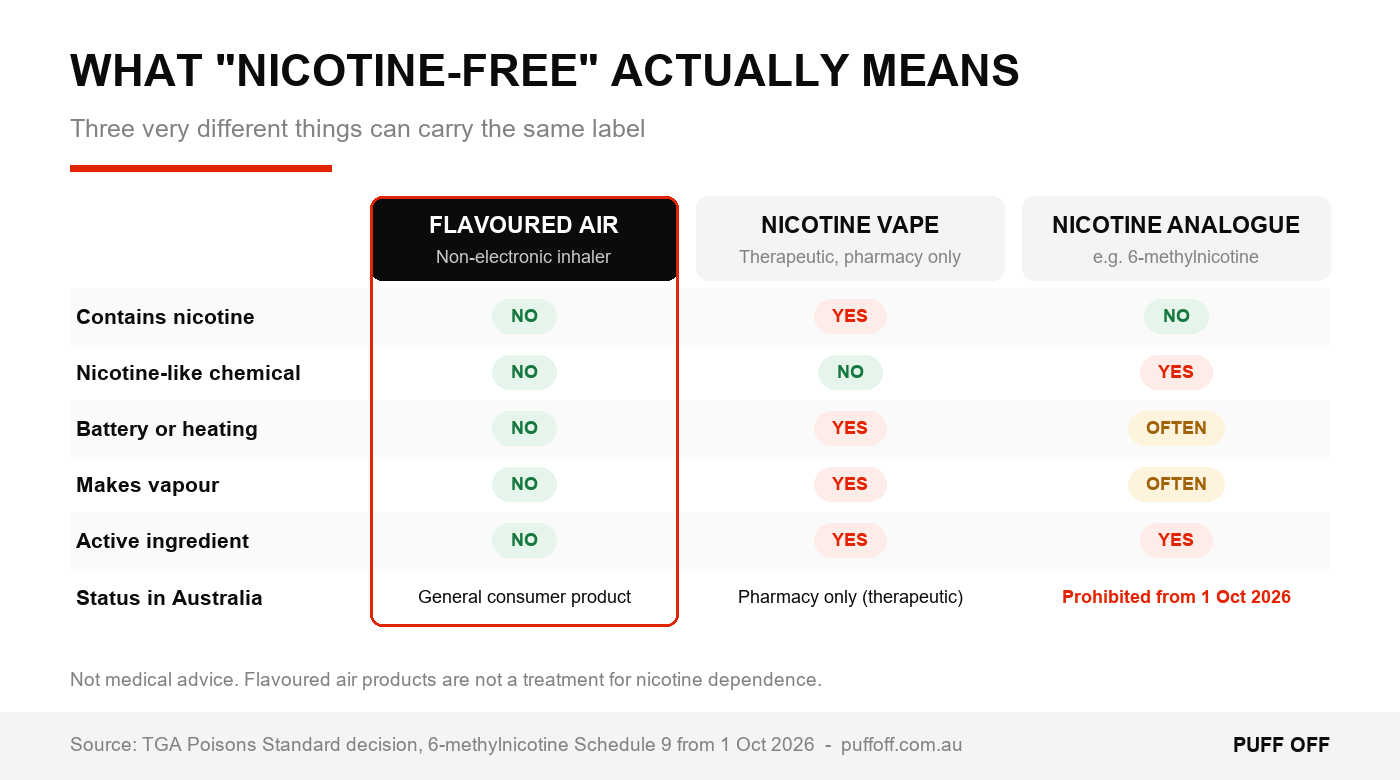
Here is how the main categories compare.
| Non-electronic flavoured air products | Nicotine vapes (therapeutic, pharmacy only) | Nicotine-analogue products (e.g. 6-methylnicotine) | |
|---|---|---|---|
| Contains nicotine | No | Yes | No, but contains a nicotine-like chemical |
| Active ingredient | None | Nicotine | Nicotine analogue |
| Battery, coil or heating | No | Yes | Often (vapes yes, pouches no) |
| Produces vapour | No | Yes | Often (vapes yes, pouches no) |
| Legal status in Australia | General consumer product | Pharmacy only, as therapeutic goods | 6-methylnicotine prohibited (Schedule 9) from 1 Oct 2026 |
1. Genuinely non-electronic, non-nicotine products
These products have no active ingredient. Flavoured air inhalers like Puff Off fall into this category: you draw air through the device and it passes over a flavour core. There is no nicotine, no tobacco and no THC or CBD. There is no battery, no coil, no heating, no liquid and no vapour, and nothing in it is designed to act on the body like nicotine.
What they offer is the ritual: something to hold, the hand-to-mouth motion, a slow breath and a bit of flavour. That is all. They are not a medicine and they do not treat nicotine dependence. They are a habit-replacement tool for people who miss the routine.
2. Nicotine vapes sold as therapeutic goods
Since 2024, nicotine vapes in Australia can only be supplied through pharmacies as therapeutic goods, under conditions that depend on your age and state. These products contain nicotine on purpose, and they are regulated as medicines for that reason.
They are not nicotine-free, and they do not claim to be. If you are considering nicotine replacement as part of a plan to stop using nicotine, that is a conversation for your GP or pharmacist.
3. Nicotine-analogue products
This is the grey zone the TGA has just addressed. These products contain no nicotine, so they could carry a "nicotine-free" label, but they contain a different compound that is chemically similar and may act on the body in a similar way. 6-methylnicotine is the best-known example, and from 1 October 2026 it is prohibited.
Why the label matters
For most people trying to change a vaping routine, the point of choosing something nicotine-free is to stop topping up nicotine, or anything like it. A product that swaps nicotine for an analogue can keep the same cycle going under a different name.
That is why clear labelling matters. "Nicotine-free" should ideally mean exactly what it says, with nothing quietly taking nicotine's place.
Questions worth asking before you buy
- What is actually inside it? Look for a full ingredient or materials list, not just "natural flavours".
- Is there an active ingredient? If yes, what is it and what does it do?
- Does it have a battery, coil or heating element? If it heats a liquid, it is a vape, whatever the label says.
- Does it produce vapour? Flavoured air products do not.
- Is the seller clear about what it is not? Honest products are upfront that they are not a medicine.
If you want to see exactly what is in a Puff Off flavour core, we break it down in what is inside a Puff Off flavour core, and our safety and compliance page covers how the device is made.
FAQ
What is 6-methylnicotine?
6-methylnicotine is a synthetic chemical that is structurally very similar to nicotine. It has been found in some vapes and oral pouches sold as "nicotine-free" or "nicotine alternatives". From 1 October 2026 the TGA classifies it as a Schedule 9 prohibited substance in Australia.
Is 6-methylnicotine banned in Australia?
Yes. The TGA's final decision lists 6-methylnicotine in Schedule 9 of the Poisons Standard from 1 October 2026. Schedule 9 is the category for prohibited substances, citing concerns about toxicity, dependence potential and misleading "nicotine-free" marketing.
Does Puff Off contain nicotine or any nicotine-like chemical?
No. Puff Off contains no nicotine, no tobacco, no THC or CBD and no nicotine analogues. It is a non-electronic inhaler with no battery, coil, heating or vapour. Air passes over a flavour core, and that is all it does.
Are flavoured air inhalers the same as vapes?
No. Vapes heat a liquid to make vapour, usually with a battery and coil. Flavoured air inhalers have no battery, no heating element and produce no vapour. You simply draw air through a flavour core.
Can a product be nicotine-free and still be addictive?
It can be, if it contains a different active compound that acts like nicotine. That concern is a key reason the TGA prohibited 6-methylnicotine. Products with no active ingredient at all, such as flavoured air inhalers, do not deliver any substance like that.
Sources: Therapeutic Goods Administration, Scheduling decisions (final), notice of final decision on 6-methylnicotine, September 2026; The Poisons Standard (SUSMP). This article is general information, not medical advice.
Keep the ritual, nothing else. Try the Puff Off Starter Kit
No nicotine, no nicotine analogues, no THC or CBD, no battery, no vapour. Just air over a flavour core.
Get the Starter Kit - $12930-day money-back guarantee - if it's not for you, you're covered.