


Moving Beyond Vaping Habits (A Realistic Step-by-Step Plan)
Most people picture quitting as one miserable week powered entirely by willpower - teeth gritted, white-knuckling every hour until the urge finally gives up. That image is exactly why so many attempts fall apart. Not because anyone’s weak, but because the plan is built on the one resource that runs out fastest under stress.
Vaping slowly attaches itself to ordinary life: the morning coffee, the drive, the moment after a meal, the work break, the stress, the boredom. At some point it stops feeling intentional and starts feeling automatic. And for most people it was never only about nicotine - it’s the routine wrapped around it. The inhale. The pause. The hand movement. The little reset in the middle of the day. Take all of that away at once and something feels missing constantly, which is why blunt “just stop” advice almost never sticks.
A better approach is to break the pattern gradually and replace the routine as you go, instead of fighting yourself every waking hour. Here’s a step-by-step way to do it that survives real life.
Key takeaways
- Willpower-only plans fail because willpower runs out exactly when triggers spike
- Swap the routine before you remove it - a gap invites the old loop back
- Small weekly targets beat dramatic promises
- One rough day does not reset your progress (UCL habit research)
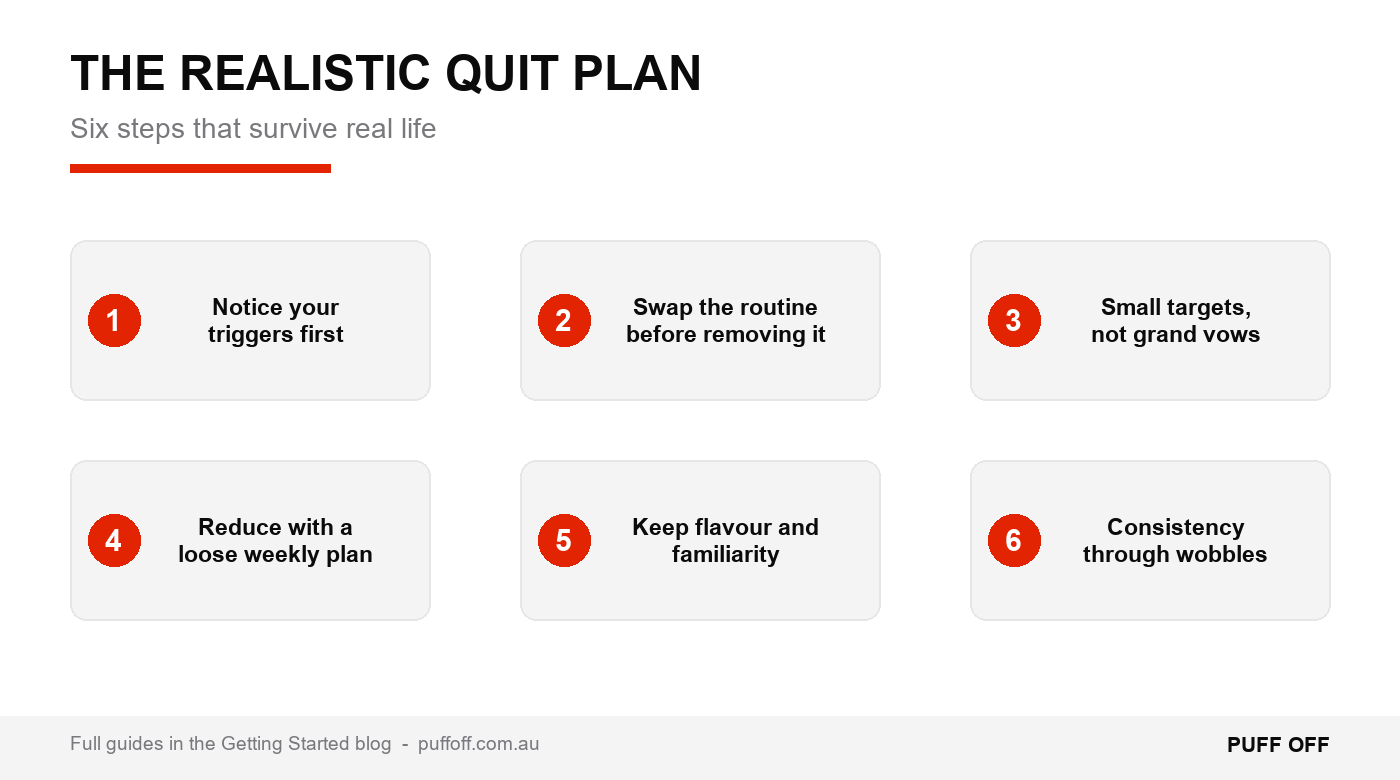
Step 1 - Notice your triggers (before you change anything)
For the first few days, don’t try to quit. Just watch. Each time you reach for the vape, make a quick mental or phone note of two things: where you were and what you were feeling. You’re gathering evidence, not handing out punishment.
Within a few days, patterns surface fast. Most people see the same culprits:
- reaching for it the moment they get in the car
- right after coffee
- during stressful or frustrating moments
- while scrolling on the phone
- out of plain boredom or restlessness
Once you can see the routine clearly, it stops being a vague “I vape too much” and becomes a specific list of moments you can actually do something about. You can’t interrupt a pattern you’ve never looked at directly. (Understanding why the habit wires in so deeply also makes this step feel less like a personal failing.)
Step 2 - Swap the routine before you remove it
This is the step most people skip, and it’s the one that makes the difference. When you delete a habit and leave a gap, your brain hunts for a stand-in - and it usually grabs something nearby like snacking, endless scrolling, or “just one.” Swapping the routine first is gentler and far more durable.
Pick your most frequent trigger and give it a replacement rather than a void:
- change the environment so the cue doesn’t fire (device off the desk, out of the cup holder)
- delay the routine (push the first session later by degrees)
- replace the familiar moment with a different action - water, a short walk, a few breaths
- use a nicotine-free alternative during the transition to keep the hand-to-mouth ritual
The goal here isn’t perfection. It’s reducing how automatic the habit feels, one trigger at a time. (For a full comparison of what to replace it with, see better alternatives to the vape routine.)
Step 3 - Make it manageable, not dramatic
Big absolute promises feel powerful for about a day. “I’m never touching it again” sets a bar so high that the first slip feels like total failure - and total failure feels like a reason to give up entirely. Smaller framing is harder to break and easier to rebuild from:
- “I’ll reduce this one trigger first.”
- “I’ll delay the first session by half an hour.”
- “I’ll break one routine at a time.”
Each small win is a deposit in your confidence, and momentum compounds. People badly underestimate how motivating a short streak of small successes is compared to one heroic, fragile promise.
Step 4 - Reduce with a loose plan
Once you’ve got a couple of triggers under control, a gentle week-by-week structure keeps you moving without turning the whole thing into a chore. It doesn’t have to be rigid - it’s a direction, not a contract:
- Week 1 - notice triggers and trim overall usage slightly
- Week 2 - delay the first vape of the day
- Week 3 - replace stress-triggered sessions with a different reset
- Week 4 - swap more routines for a nicotine-free alternative
Adjust the pace to your life. Some people move faster, some slower. The structure is there to give you a next step, not to shame you when a week doesn’t go to plan.
Step 5 - Don’t underestimate flavour and familiarity
Here’s a quiet reason replacements fail: they feel bland or restrictive, so the brain files them as “punishment” and drifts back to the old pattern within days. If an alternative doesn’t feel at least a bit enjoyable, you won’t keep reaching for it when it matters.
Keeping some familiarity - a satisfying hand-to-mouth ritual, flavours you actually like, the sense of a real break rather than a deprivation - is often what makes a change stick. That’s the idea Puff Off was designed around: nicotine-free, a familiar hand-to-mouth ritual, and a flavour-focused experience, built to change the routine without making daily life feel miserable. It’s one option among several, but it speaks directly to the reason a lot of replacements get abandoned.
Step 6 - Stay consistent through the wobbles
No plan runs clean. Some days will be easy, some will test you, and at least one will go sideways. The people who get there aren’t the ones who never stumble - they’re the ones who keep interrupting the cycle instead of sliding fully back into autopilot after a rough patch.
The research is genuinely reassuring on this. In University College London’s habit formation study, new routines took 66 days on average to become automatic - and missing a single day made no measurable difference to the end result. One rough Tuesday doesn’t undo three good weeks. The habit maths simply doesn’t work that way.
A few hard days don’t erase weeks of progress. One slip isn’t failure; it’s feedback about which trigger still needs work. The whole game is to keep going long enough that the routine loses its grip - and it does lose its grip, more than you’d believe from the early days. For a realistic picture of that stretch, see what the first few weeks actually feel like.
Your simple starting plan
If you want to begin today, keep it light:
- Notice your biggest triggers for a few days.
- Change the routine around one of them first.
- Keep the process manageable - small targets, not grand vows.
- Track your progress so you can see it building.
- Choose consistency over perfection, every time.
That’s usually where real momentum begins - not with a dramatic, willpower-fuelled week, but with a series of small, repeatable changes that quietly add up.
FAQ
Can you quit vaping without using nicotine replacements?
Yes. Plenty of people move past vaping by focusing on the routine side - mapping triggers, replacing rituals, and changing their environment - rather than swapping one nicotine source for another. A nicotine-free ritual replacement can help with the hand-to-mouth habit, but the core of the plan is interrupting the loop, not the chemistry alone.
What’s the first step to quitting vaping?
Before changing anything, spend a few days simply noticing when and why you reach for it - no pressure to stop yet. That awareness turns a vague goal into a specific list of triggers you can actually plan around, and it often starts reducing usage on its own.
Is it better to quit gradually or all at once?
For most people, gradual works better because it doesn’t depend on willpower staying high every day. Swapping routines one trigger at a time, with a replacement in place, tends to be more sustainable than going cold and leaving a gap the old habit can rush back into. Some people do well going faster - match the pace to what you can keep up.
How do I stop vaping when I’m stressed?
Stress urges are really a request for a fast reset, so prepare a different reset in advance: a short walk, slow breathing, water, stepping away, or a nicotine-free ritual replacement. Deciding your response before the stressful moment arrives beats trying to negotiate with yourself in the middle of it.
How long does the whole process take?
There’s no fixed timeline - it depends on how many routines vaping is tied to and how consistently you interrupt them. Many people notice the physical side easing within a couple of weeks, while fully unwinding the habit takes longer. Steady, consistent change matters far more than speed.
Ready to start? Try the Puff Off Starter Kit
When you’re ready to swap the routine instead of just removing it, this is the easiest way to do it.
The Puff Off Starter Kit is built to keep the routine you’re working to change - nicotine-free, flavour-focused, and easy to keep in your pocket for the moments that test you.
Get the Starter Kit - $12930-day money-back guarantee - if it's not for you, you're covered.