


Quitting Smoking in Australia: The Habit Layer Nobody Plans For (2026)
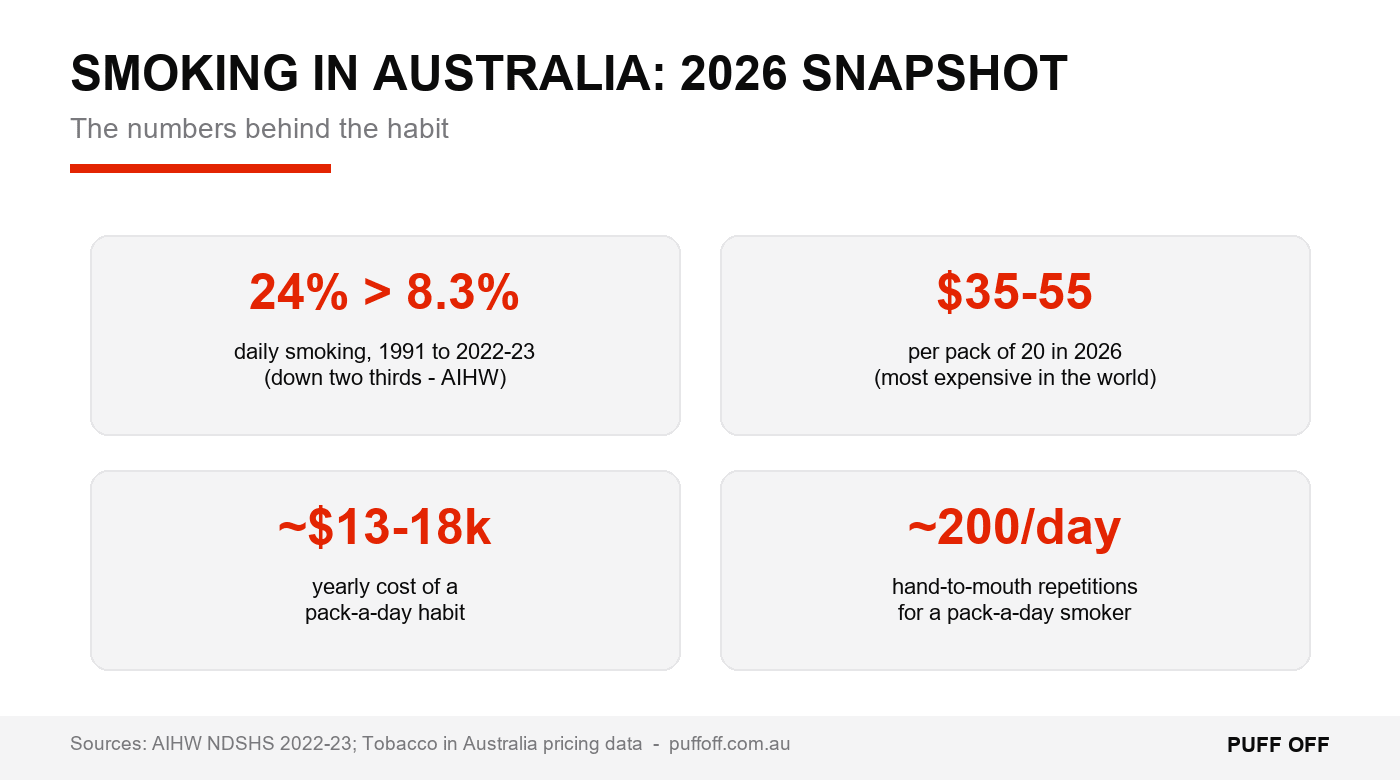
Australia is one of the hardest places in the world to keep smoking. Daily smoking has fallen by two thirds, from 24% in 1991 to 8.3% in 2022-23 according to the Australian Institute of Health and Welfare, and a pack of 20 now costs between $35 and $55, the most expensive cigarettes on earth. Free support exists at every turn: Quitline, your GP, subsidised nicotine replacement. And yet people who genuinely want to stop still find themselves lighting up on autopilot. This guide is about the layer most quit plans skip: the hand-to-mouth habit that keeps running long after you have decided you are done.
One thing before we start: this is general information, not medical advice. For nicotine dependence, your GP or pharmacist is the right first stop.
Key takeaways
- Daily smoking in Australia fell from 24% in 1991 to 8.3% in 2022-23 (AIHW) - millions have done this
- A pack-a-day habit at 2026 prices costs roughly $13,000 to $18,000 a year
- Nicotine is one layer; the hand-to-mouth ritual repeated ~200 times a day is the other
- Free help exists: Quitline 13 7848, the My QuitBuddy app, your GP or pharmacist
The part of smoking nobody warns you about
Most quit plans attack the nicotine: patches, gum, lozenges, prescriptions, willpower. That is the right first move, and it is exactly what your GP or pharmacist can help you structure properly.
But think about what a pack-a-day smoker actually rehearses. Around ten puffs per cigarette, twenty cigarettes a day - that is roughly 200 hand-to-mouth repetitions every single day, over 70,000 a year. Each one is wired to a moment: the coffee, the drive, the work break, the phone call, the wind-down beer. University College London research on habit formation found routines take 66 days on average to become automatic. A smoking habit has usually had decades.
That is why so many people manage the nicotine side and still relapse weeks later. The chemistry was handled. The choreography was not. The hands still expect something at 3pm. The break still feels incomplete. The moment after dinner still has a hole in it.
What quitting smoking in Australia looks like in 2026
The support system here is genuinely world class, and it is worth using all of it:
- Your GP or pharmacist. The frontline for nicotine dependence. They can structure nicotine replacement therapy, discuss prescription options, and tailor a plan to how much and how long you have smoked.
- Quitline (13 7848). Free, confidential counselling. Evidence consistently shows support and accountability improve quit outcomes.
- My QuitBuddy. The Australian Government's free app: tracking, milestones, craving timers.
- Price pressure. At $35-55 a pack, the maths does some of the motivating for you. A pack-a-day smoker who quits saves roughly $13,000 to $18,000 a year at 2026 prices.
What that list does not cover is the ritual. Every tool above targets nicotine or motivation. None of them gives your hands something to do at the moments the old routine owns.
Planning for the habit layer
The same behavioural playbook that works for vaping works here, because underneath, it is the same loop: cue, routine, reward.
- Map your triggers first. For a week, note when you smoke and what was happening. Most people find their cigarettes cluster around a handful of repeat moments: waking, coffee, driving, breaks, meals, stress, the evening wind-down.
- Interrupt one trigger at a time. Change where you have your coffee. Take the break somewhere different. One trigger for one week, then the next. Dramatic overnight overhauls collapse; small interruptions compound.
- Give the ritual somewhere to land. When the hand reaches, it needs an answer that is not "just resist." Water, a walk, slow breaths - and some adults keep the familiar hand-to-mouth motion with a nicotine-free flavoured air inhaler like Puff Off. No smoke, no vapour, no nicotine, no batteries: a habit tool, not a therapeutic product, built for exactly those 200 daily moments.
- Treat slips as data. The UCL research found missing a single day made no measurable difference to habit outcomes. One cigarette on a bad Tuesday is information about a trigger, not a verdict on you.
We have written about this loop in depth, and the mechanics are identical whether the old routine involved a lighter or a charger: see the hand-to-mouth habit and why it outlasts everything and what the first few weeks actually feel like.
The encouraging maths
Two thirds of Australia's daily smokers are gone since 1991. That is not a statistic about willpower heroes; it is millions of ordinary people, most of whom needed several attempts, working through exactly the layers above. The average successful quitter is not the strongest person in the room. They are the one who kept adjusting the routine until it stopped feeling automatic.
Our founder Sam smoked for 20 years before switching to vaping for another 8, and the thing that finally made the difference was not a stronger will. It was realising the ritual needed its own plan. His story is here.
General information only, not medical advice. For help with nicotine dependence, talk to your GP or pharmacist, or call Quitline on 13 7848.
FAQ
What is the best way to quit smoking in Australia?
There is no single best way, but the strongest evidence supports combining professional support (GP or pharmacist), free services like Quitline (13 7848) and the My QuitBuddy app, and a concrete plan for the habit side: mapping your trigger moments and giving the hand-to-mouth ritual a replacement rather than a vacuum.
How much does smoking cost in Australia in 2026?
A pack of 20 cigarettes costs between $35 and $55 in 2026, the most expensive in the world. A pack-a-day smoker spends roughly $13,000 to $18,000 a year depending on brand, which is one of the strongest practical motivators for quitting.
Why do I still want a cigarette after the nicotine cravings stop?
Because smoking is two habits in one: a nicotine dependence and a physical ritual repeated around 200 times a day for a pack-a-day smoker. Nicotine replacement handles the first. The hand-to-mouth routine needs its own replacement, or it keeps firing at your old trigger moments long after the chemistry settles.
How many Australians still smoke?
About 8.3% of Australians aged 14 and over smoked daily in 2022-23 according to the AIHW's National Drug Strategy Household Survey, down from 24% in 1991. The decline is one of the steepest in the world.
Can a nicotine-free inhaler help me quit smoking?
A nicotine-free flavoured air inhaler is a habit tool, not a therapeutic product, and it does not treat nicotine dependence. What it can do is give the hand-to-mouth ritual somewhere to land while you work on the nicotine side with your GP, pharmacist or Quitline. Many people find the ritual is the part that trips them up after the chemistry is handled.
Ready to start? Try the Puff Off Starter Kit
If the ritual is your hard part, give those 200 daily moments somewhere to land.
The Puff Off Starter Kit keeps the hand-to-mouth routine - nicotine-free, flavour-focused, no batteries, and easy to keep in your pocket for the moments that test you.
Get the Starter Kit - $12930-day money-back guarantee - if it's not for you, you're covered.