


Vaping Laws in Australia: What Changed and What It Means for You
Australia now has some of the tightest vaping rules in the world, and they changed fast enough that a lot of people are still working off old information. This is the plain summary.
One caveat up front, and it matters: rules in this area change, and the detail differs by state. Treat this as orientation, not legal advice. For the current position, the Therapeutic Goods Administration and your state health department are the authorities.
Key takeaways
- Across 2024 Australia moved vaping from a consumer product to a therapeutic one
- Disposable vapes were banned from import, and non-therapeutic vapes followed
- Legal supply moved to pharmacies, not convenience stores or vape shops
- The practical effect for most people: the casual purchase path closed
What changed
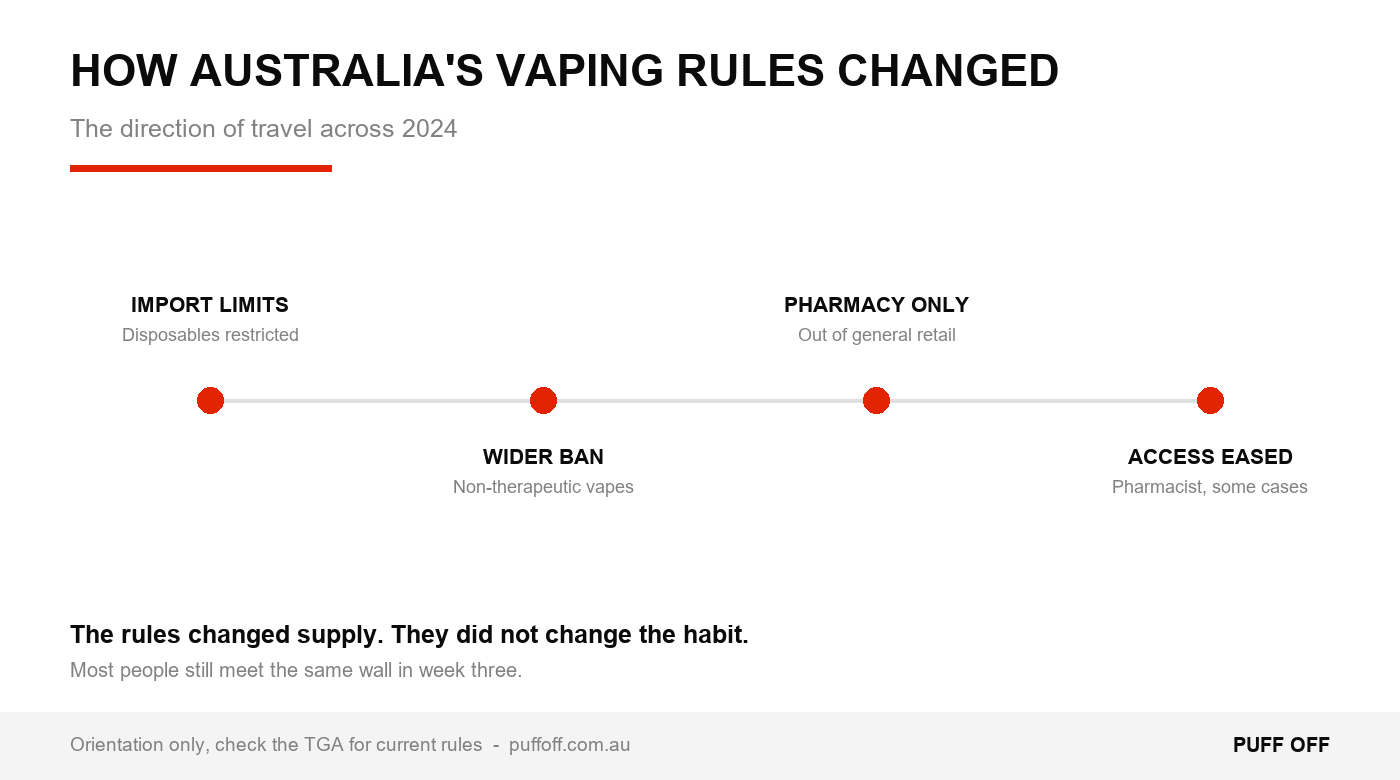
The reforms rolled out in stages through 2024, and the direction was consistent throughout: move vaping out of general retail and into the pharmacy system.
Import restrictions. Australia moved to ban the importation of disposable vapes, and then extended restrictions to non-therapeutic vapes more broadly. This was the lever that mattered most, because almost all product was imported.
Supply moved to pharmacies. Legal supply of therapeutic vapes shifted to pharmacies rather than general retail. Convenience stores, tobacconists and vape shops are not a legal supply channel for nicotine vaping products.
Product standards tightened. Rules covering flavours, packaging and nicotine concentration were tightened, aimed squarely at products designed to appeal to younger users.
Access without a prescription, in some cases. Later in 2024 the rules were adjusted so that adults could in some circumstances obtain lower-strength products from a pharmacist without a prescription, subject to pharmacist assessment. Exact conditions vary and pharmacies are not obliged to stock or supply.
What this means practically
If you currently vape. The casual purchase route is gone. Anything sold from a shop counter outside a pharmacy is outside the legal supply chain, which also means it is not subject to the product standards the reforms introduced. You genuinely do not know what is in it.
If you want to stop. The pathway now runs through a pharmacist or doctor, which is worth using rather than resenting. A pharmacist can walk you through nicotine replacement options, and that conversation is free.
If you never started. Nothing here applies to you, and the entire debate is one you get to skip.
The part the rules do not address
Worth naming, because it is the gap people fall into.
Regulation changes supply. It does not change the habit. Making a product harder to buy removes the convenience, and for some people that is enough of a nudge. For a lot of people it produces a different outcome: they stop being able to buy easily, they try to stop, and they run straight into the same wall they would have hit anyway.
That wall is the hand-to-mouth ritual, which is the same whether the product is legal, illegal, pharmacy-only or banned outright. We wrote about why it outlasts everything else in the hand-to-mouth habit.
Where a nicotine-free ritual sits
Puff Off is not a vape and not a therapeutic product. It is a non-electronic aromatherapy inhaler: no battery, no heating element, no coil, no vapour, and no nicotine, tobacco, THC or CBD. It is not affected by the vaping reforms because it is not in that category, and it is not a medicine, so we make no health claims for it.
We mention it because "what am I supposed to do with my hands now" is the practical question the rule changes leave people with, and that is the specific problem it addresses.
FAQ
Is vaping illegal in Australia?
Vaping itself is not illegal, but supply is tightly controlled. Nicotine vaping products moved into the pharmacy system through the 2024 reforms, and non-pharmacy retail sale is not a legal supply channel. Rules vary by state, so check current guidance.
Can you still buy vapes in Australia?
Legal supply runs through pharmacies rather than general retail. Products sold from convenience stores, tobacconists or vape shops fall outside that channel, which also means they are not covered by the product standards the reforms introduced.
Are disposable vapes banned in Australia?
Australia moved to ban the importation of disposable vapes as part of the 2024 reforms, with restrictions later extended to non-therapeutic vapes more broadly.
Do I need a prescription to get a vape in Australia?
The rules were adjusted during 2024 so adults can in some circumstances obtain lower-strength products from a pharmacist without a prescription, subject to pharmacist assessment. Conditions vary and pharmacies are not required to supply.
Is a nicotine-free inhaler affected by the vaping laws?
A non-electronic, nicotine-free flavoured air inhaler is not a vaping product and does not contain nicotine, tobacco, THC or CBD. It is also not a therapeutic product, so it is a consumer item rather than something covered by the vaping reforms.
The rules changed. The habit did not.
If the supply squeeze is what finally pushed you to stop, the reach is the part still waiting for you.
Get the Starter Kit - $12930-day money-back guarantee - if it's not for you, you're covered.