


Quit Vaping Inhalers: The Two Types and Which One You Need
Search "quit vaping inhaler" and you get two completely different products sharing one name. They look similar, they are held the same way, and they solve opposite halves of the problem. Buying the wrong one is the most common reason people conclude that inhalers do not work.
Here is how to tell them apart in about ten seconds.
Key takeaways
- Type 1 is a nicotine inhalator: a pharmacy product that delivers nicotine
- Type 2 is a nicotine-free inhaler: a consumer product that delivers flavour on air
- One treats withdrawal. The other covers the ritual. Neither does both
- The fastest sort: does it contain nicotine, and did it come from a pharmacy
Type 1: the nicotine inhalator
A plastic mouthpiece holding a replaceable nicotine cartridge. You draw on it and absorb nicotine through the lining of your mouth rather than your lungs.
What it is for: chemical withdrawal. Cravings, irritability, headaches, the fog of the first fortnight.
Where you get it: a pharmacy. It is a therapeutic product and it sits within nicotine replacement therapy, alongside patches, gum, lozenges and spray.
Why people like it: it is the only nicotine replacement product that also occupies your hands. Patches do nothing for the reach and gum only covers your mouth. The inhalator accidentally covers part of the ritual as well as the chemistry, which is why it suits people who miss the physical action.
The honest limitation: you are still using nicotine. That is entirely reasonable as a step down, and it is what the product is designed for, but it does not end the dependency on its own.
Type 2: the nicotine-free inhaler
A non-electronic device holding a flavour core. You draw on it and air carries flavour with it. No nicotine, no liquid, no battery, no heat, no vapour.
What it is for: the ritual. The automatic reach, the draw, the flavour, the pause, the exhale.
Where you get it: ordinary retail. It is a consumer product, not a medicine.
Why people like it: it completes the whole hand-to-mouth sequence rather than part of it, and there is nothing to charge or refill with liquid.
The honest limitation: it does nothing for nicotine withdrawal. If you stopped yesterday and feel physically terrible, this is not the product for that week.
The ten-second sort
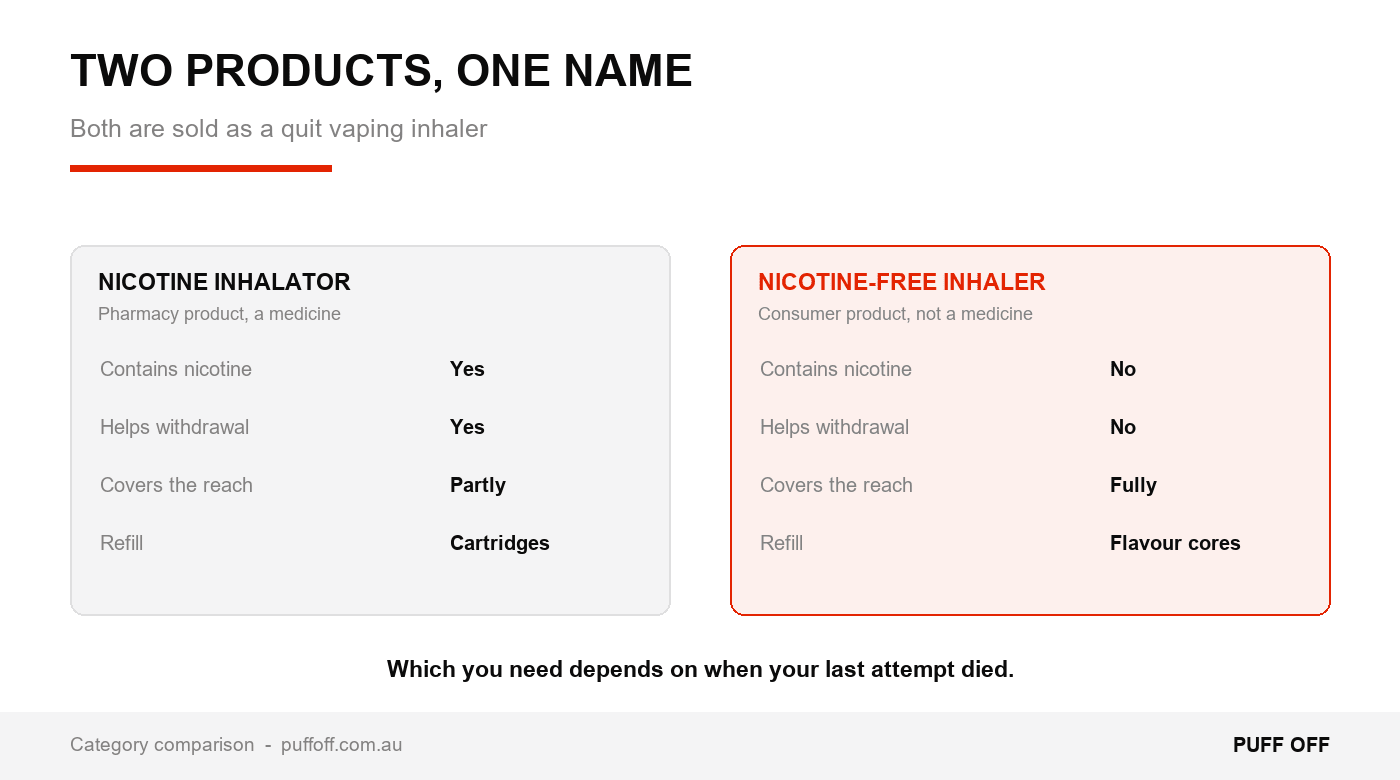
| Nicotine inhalator | Nicotine-free inhaler | |
|---|---|---|
| Contains nicotine | Yes | No |
| Sold at | Pharmacy | General retail |
| Is it a medicine | Yes | No |
| Helps withdrawal | Yes | No |
| Covers the reach | Partly | Fully |
| Ongoing item | Nicotine cartridges | Flavour cores |
If a product contains nicotine and did not come from a pharmacy, that is worth a second look given how Australian supply rules now work.
Which one do you need
The useful diagnostic is when your previous attempts died.
- Collapsed in the first week, feeling physically wretched? That is withdrawal. Type 1, and talk to a pharmacist about combining it with a patch.
- Collapsed in week three or later, feeling physically fine but restless and reaching? That is the ritual. Type 1 will not help much here because withdrawal has already passed. You want Type 2.
- Not sure? Most people need both, for different weeks. They do not conflict, though since nicotine inhalators are medicines it is worth telling your pharmacist what else you are using.
We looked at the wider device landscape, including trackers and fidget tools, in the best devices for quitting vaping.
Where ours sits
Puff Off is firmly Type 2. A wooden, non-electronic inhaler running on food-grade flavour cores, with no nicotine, tobacco, THC or CBD, no battery, coil or heating element. It is not a medicine, not nicotine replacement therapy and not a vape, and we make no health claims for it.
If you are in your first week and the withdrawal is the thing beating you, a pharmacist is a better first stop than us. If you are past that and your hand still goes up at 9pm, that is exactly the gap this fills.
FAQ
What is a quit vaping inhaler?
The term covers two different products. One is a pharmacy nicotine inhalator that delivers nicotine to ease withdrawal. The other is a nicotine-free inhaler that carries flavour on air and addresses the hand-to-mouth ritual rather than the chemistry.
Does a nicotine inhalator work for quitting vaping?
It is a recognised form of nicotine replacement and it reduces withdrawal symptoms, which makes the early weeks more survivable. It does not by itself remove the habit of reaching, which is why many people pair it with something behavioural.
Is a nicotine-free inhaler better than a nicotine inhalator?
Neither is better, they solve different problems. Nicotine inhalators address chemical withdrawal, nicotine-free inhalers address the ritual. Which is right depends on which one is beating you.
Can I use both at the same time?
Many people do, since they target different things. Nicotine inhalators are medicines, so mention anything you are using alongside them to your pharmacist or doctor.
Do I need a prescription for a nicotine inhalator in Australia?
Nicotine replacement products are supplied through pharmacies, and requirements vary by product and have changed in recent years. Ask a pharmacist, who can also advise on the right form and dose for your usage.
For the half a pharmacy cannot sell you
If withdrawal is handled and the reaching is not, that is the gap.
Get the Starter Kit - $12930-day money-back guarantee - if it's not for you, you're covered.