


The Best Devices for Quitting Vaping (And How to Judge One)
Search for a device to help you stop vaping and you get a wall of products that look similar, cost wildly different amounts, and describe themselves in nearly identical language. Almost none of them explain what they actually do.
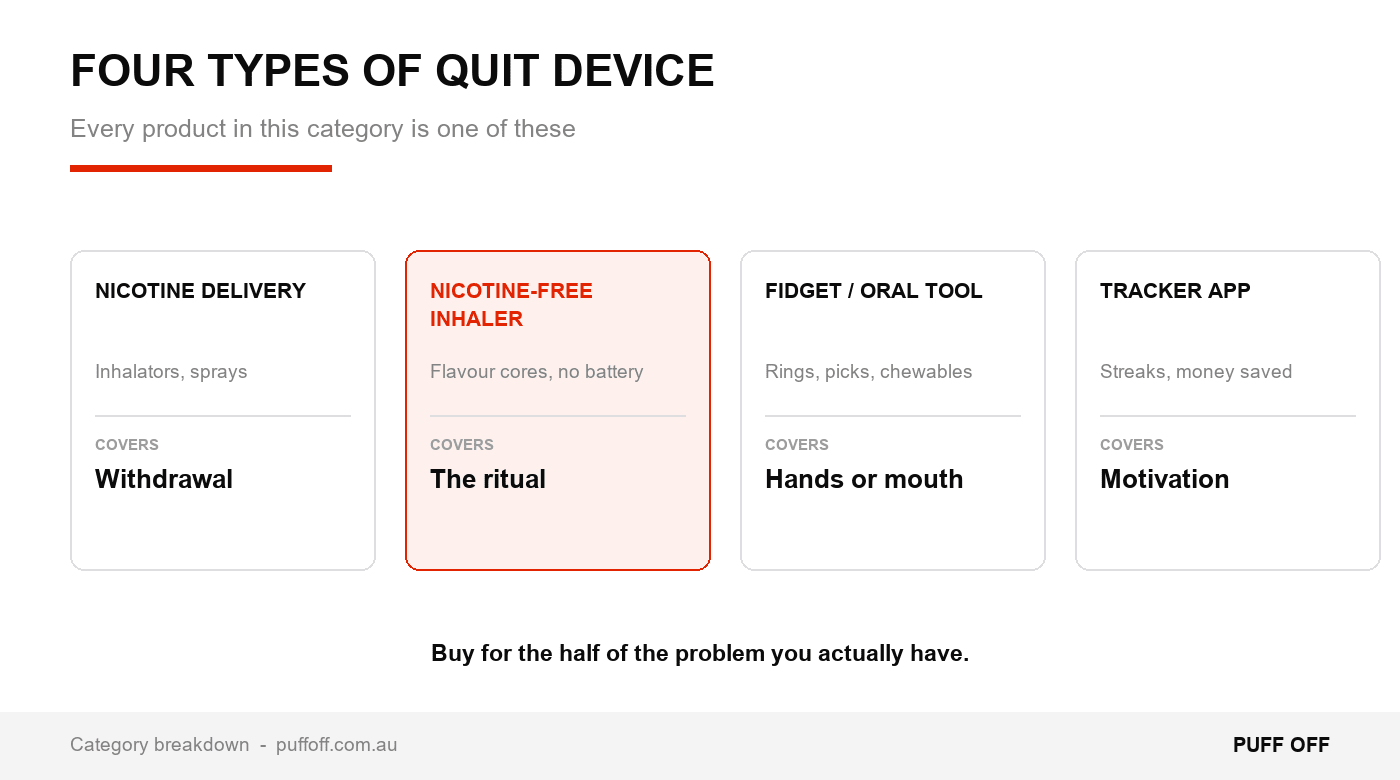
There are only four types. Once you can tell them apart, choosing is straightforward.
Key takeaways
- Every quit device is one of four types: nicotine delivery, nicotine-free inhaler, fidget or oral tool, or tracker app
- Devices that deliver nicotine solve withdrawal. Devices that do not solve the ritual. Know which you are buying
- The most common buying mistake is picking on looks rather than on which half of the problem it addresses
- Ask the five questions below before spending anything
The four types
Type 1. Nicotine delivery devices. Inhalators and mouth sprays from a pharmacy. These supply nicotine in a controlled dose. The inhalator is the interesting one, because it is the only pharmacy product that also gives your hands something to do. Regulated as medicines, so a pharmacist is the right person to ask.
Type 2. Nicotine-free inhalers. Non-electronic devices with flavoured cores or air. No nicotine, no vapour, no battery. They cover the ritual and nothing else. This is the category Puff Off sits in. They will not touch chemical withdrawal, and any product in this category claiming to is overreaching.
Type 3. Fidget and oral tools. Rings, chewable pendants, textured picks. Cover the hands or the mouth in isolation. Cheap, discreet, and partial.
Type 4. Tracker apps. Not physical, but they belong on the list because they change behaviour. Streaks, money saved, milestones. Good for the motivation side, useless in the moment a craving lands.
The five questions worth asking
Before you buy anything in this category, run it through these.
1. Does it contain nicotine? This single question sorts every product into the two halves of the problem. If it does, it is a withdrawal tool and probably a pharmacy item. If it does not, it is a ritual tool. Neither is better, they are different jobs.
2. Does it need charging, heating or liquid? Anything with a battery and a coil is closer to the thing you are leaving than to a replacement for it. If part of your reason for stopping is not wanting a device that needs charging, check this before you buy.
3. Does it cover the whole sequence? Reach, draw, flavour, pause, exhale. Products covering two of five feel like they are missing something, because they are. This is the most common reason a device ends up in a drawer.
4. What is the ongoing cost? The device price is rarely the real number. Ask what the consumables cost per month and compare that against your current spend, not against zero.
5. Is there a refund if it does not suit you? This category has a high rate of "seemed like a good idea." A money-back guarantee is the honest signal that a company expects it to work for most people.
Which type suits which person
- Withdrawal is your main obstacle. Type 1, from a pharmacy, ideally combined with a patch. Add a type 2 before week three.
- You feel physically fine but keep reaching. Type 2. This is the ritual problem and nicotine will not fix it.
- You need discretion at work. Type 3 for meetings, type 2 for breaks.
- You are motivated but keep losing track. Type 4 alongside whichever of the others fits.
- You have failed at week three before. That timing points at the ritual almost every time. Type 2.
Where Puff Off sits, plainly
Puff Off is a type 2 device. A wooden, non-electronic inhaler that runs on flavour cores. No nicotine, no tobacco, no vapour, no battery, no coil, no liquid.
It is not a medicine, it is not nicotine replacement therapy, and we do not claim it treats anything. What it does is complete the hand-to-mouth sequence so the motion has somewhere to land. If your problem is chemical withdrawal in the first 72 hours, this is not the tool for that part. If your problem is that your hand keeps going up at 9pm, it is exactly the tool.
The kit is $129, cores run around $29 a month, and there is a 30-day money-back guarantee, which covers question five.
FAQ
What is the best device to help quit vaping?
It depends which half of the problem you have. Pharmacy nicotine inhalators and sprays address withdrawal. Nicotine-free inhalers address the hand-to-mouth ritual. Fidget tools cover the hands or mouth partially, and tracker apps support motivation rather than the moment of craving.
Do quit vaping devices actually work?
They work when matched to the right problem. People who buy a ritual replacement for chemical withdrawal, or nicotine replacement expecting it to stop them reaching, usually conclude the device failed when it was aimed at the wrong half.
Is a nicotine-free vape a good quitting device?
It keeps the motion but still involves a battery, a coil and inhaling vapour, which for many people is too close to the habit they are leaving. A non-electronic flavoured air inhaler covers the ritual without any of those.
How much should a quit vaping device cost?
Look at ongoing cost rather than upfront. A device with cheap consumables can cost more over a year than a pricier one with inexpensive refills. Compare the monthly figure against your current spend.
What if the device does not work for me?
Check for a refund policy before buying. This category has a high abandonment rate, and a money-back guarantee is a reasonable signal of confidence.
If the ritual is your half of the problem
No battery, no coil, no liquid, no nicotine. Just the sequence.
Get the Starter Kit - $12930-day money-back guarantee - if it's not for you, you're covered.