


Nicotine Replacement Therapy Explained (And What It Is Not)
If you have started looking into quitting, you have run into the letters NRT. Nicotine replacement therapy is the umbrella term for products that give you a controlled dose of nicotine without the smoke or the vapour, so the withdrawal side of quitting is less brutal while you break the habit.
It is well studied and it helps a lot of people. It is also frequently misunderstood, mostly because of what people expect it to do. Here is the honest version: what NRT is, what it handles, and the part it was never designed to touch.
Key takeaways
- NRT gives you nicotine without the smoke or vapour, to soften withdrawal
- It is designed to solve the chemical side of quitting, not the behavioural side
- The most common reason people say "NRT did not work for me" is that the habit was the real problem
- Puff Off is not NRT. It contains no nicotine at all and is not a medicine
What NRT actually is
Nicotine replacement therapy delivers a measured amount of nicotine through a route that is not smoking or vaping. The usual forms are:
- Patches. Slow, steady release through the skin across the day. Good for baseline cravings, useless for a sudden spike.
- Gum. Faster acting, and you control when you use it. Needs a specific chew-and-park technique to work properly, which almost nobody is told.
- Lozenges. Similar speed to gum, no chewing, dissolve slowly in the mouth.
- Mouth spray. The fastest of the group, usually within a minute or two, which makes it the one people reach for during a peak.
- Inhalators. A plastic mouthpiece with a nicotine cartridge. Notably, this is the one form that also gives you something to hold and draw on.
In most countries these are available from a pharmacy, and some are subsidised. In Australia, several are on the PBS with a prescription. Your pharmacist is genuinely the right person to ask about which form suits you, and it is a free conversation.
What NRT is good at
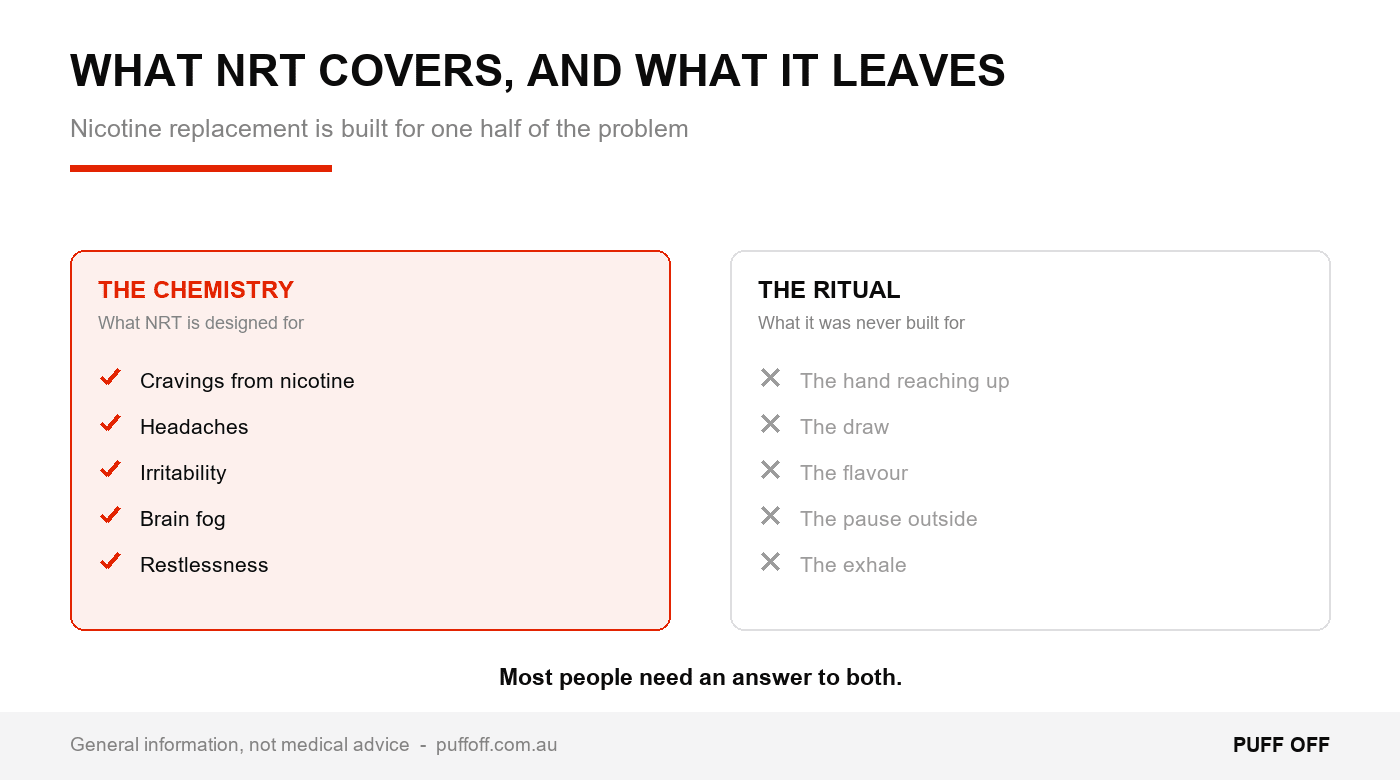
The evidence here is solid and not really in dispute: using NRT properly makes it more likely you will get through the first few weeks than going with nothing at all. It flattens the worst of the withdrawal curve, which is the stretch where most attempts collapse.
If your quit attempts have failed because you felt physically wretched, foggy and furious for three days and simply could not take it any more, NRT is aimed directly at that problem.
Two things worth knowing, because they trip people up:
Most people under-dose. Using one piece of gum a day when you were a heavy user is not really a trial of NRT. The usual advice is to use enough, use it on a schedule rather than only in emergencies, and step down over weeks.
Combining forms works better than one alone. A patch for the baseline plus a fast-acting form for spikes is the standard recommendation, and it consistently outperforms a patch on its own.
What NRT was never designed to do
Here is the gap.
Nicotine replacement replaces the nicotine. It does not replace the reaching, the inhale, the pause outside, the thing in your hand at the end of a meal, the flavour, or the exhale that your body reads as a break.
That is not a criticism of NRT. It is simply out of scope. A patch on your arm cannot give you something to do with your hands at 9pm.
And for a lot of people, that is the part that actually breaks the quit. You get through the chemical withdrawal, you are genuinely past the worst of it, and then three weeks later you are standing on a balcony at a party with nothing to hold, and your hand goes looking. We wrote about why that reach outlasts the chemistry in the hand-to-mouth habit.
Where a nicotine-free ritual sits
This is the part where we should be precise, because the distinction matters.
Puff Off is not nicotine replacement therapy. It contains no nicotine, no tobacco and no medicine of any kind. It is not a treatment, and we do not claim it treats anything. It is a wooden, non-electronic inhaler with flavour cores that gives you the hand-to-mouth ritual: reach, draw, flavour, pause, exhale. No batteries, no vapour.
So it does not compete with NRT. It sits on the other side of the problem. NRT is aimed at the chemistry. A nicotine-free ritual is aimed at the behaviour. Some people use one, some use the other, and plenty of people use both at the same time for different reasons.
If you are currently on patches or gum and still finding your hands restless in the evening, that is exactly the gap we are describing. It does not mean the NRT is failing. It means the other half is unaddressed.
How to decide
A rough guide, and your pharmacist or doctor will do better than an article:
- Withdrawal is your main enemy (headaches, rage, fog, sleep wrecked) - talk to a pharmacist about NRT, and ask about combining a patch with a fast-acting form.
- The routine is your main enemy (you feel fine but keep reaching, especially with coffee, after meals, in the car, at 9pm) - a behavioural replacement is the more direct answer.
- Both - which is most people, honestly - use both. They do not conflict.
Whatever you choose, use it properly and give it more than a couple of days. Most people who say a method did not work stopped before it had a fair run.
FAQ
What is nicotine replacement therapy?
Nicotine replacement therapy is a group of products that give you a controlled dose of nicotine without smoke or vapour, to reduce withdrawal symptoms while you stop smoking or vaping. Common forms are patches, gum, lozenges, mouth spray and inhalators.
Does nicotine replacement therapy work?
The evidence says using it properly makes it more likely you will get through the early weeks than using nothing. It works best when the dose is high enough, used on a schedule rather than only in emergencies, and when a patch is combined with a faster-acting form.
Is Puff Off nicotine replacement therapy?
No. Puff Off contains no nicotine, no tobacco and no medicine, and it is not a treatment for anything. It is a non-electronic flavoured air inhaler aimed at the hand-to-mouth ritual, which is a different problem from nicotine withdrawal.
Can I use a nicotine-free inhaler alongside NRT?
They address different things, so many people do use both. Since NRT is a medicine, ask your pharmacist or doctor about anything you are taking alongside it, especially if you are on a prescription form.
Why did NRT not work for me last time?
The two most common reasons are under-dosing and stopping too early. The third is that the real problem was behavioural rather than chemical, in which case the nicotine was never the part that needed replacing.
The half NRT does not cover
If the chemistry is handled and your hands still are not, that is the gap.
Get the Starter Kit - $12930-day money-back guarantee - if it's not for you, you're covered.