


The Menthol Cigarette Ban in Australia: What Changed and What People Do Now
If your brand disappeared from the shelf and nobody explained why, this is the explanation. Menthol cigarettes are no longer legally sold in Australia, and the ban is broader than just the word "menthol" on a pack.
One caveat: tobacco law changes and detail varies. For the current position the Australian Government Department of Health is the authority. This is orientation.
Key takeaways
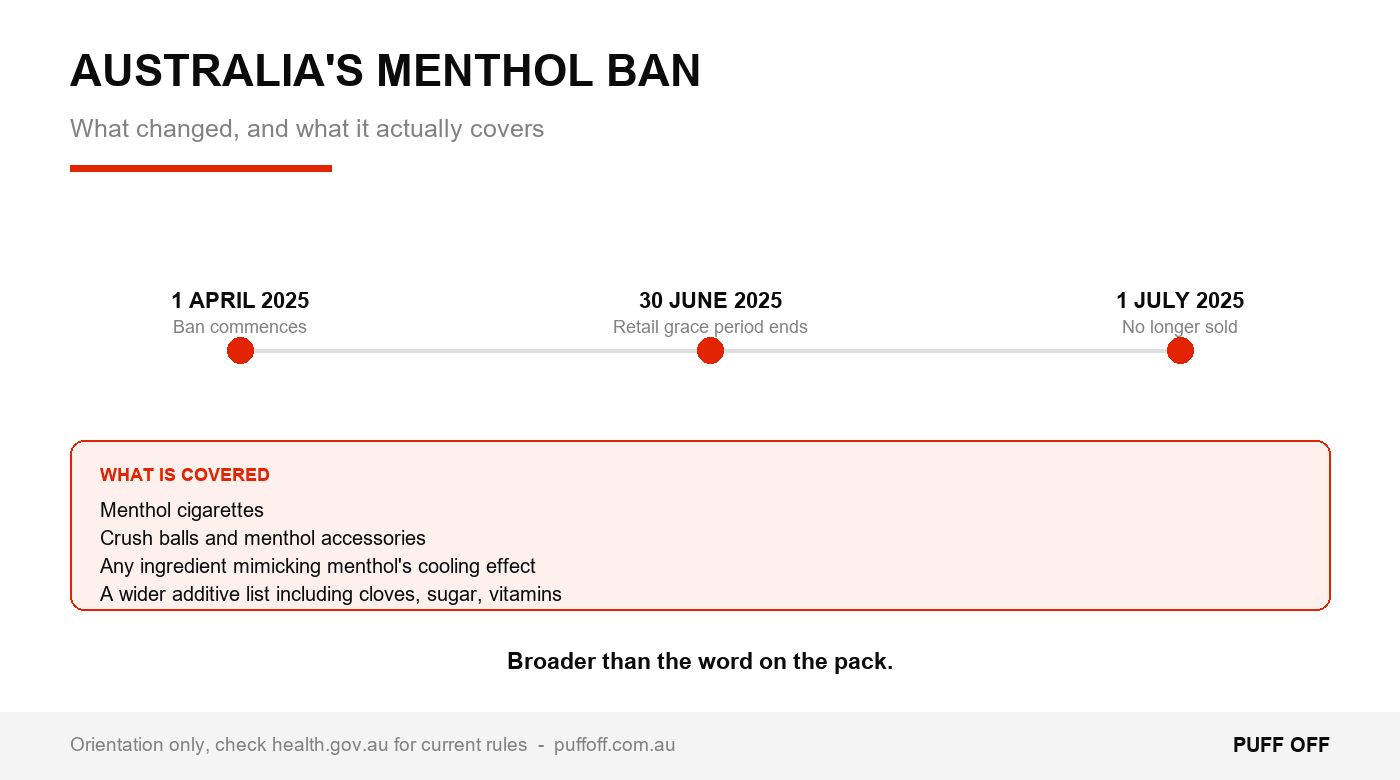
- The ban commenced 1 April 2025, with a retail grace period ending 30 June 2025
- From 1 July 2025 menthol cigarettes and menthol accessories are no longer sold
- It covers crush balls and cooling additives, not just products labelled menthol
- Menthol smokers are the group who most often report the flavour being what they miss
What the law actually covers
The reforms sit within Australia's broader tobacco overhaul, and they prohibit a long list of additives rather than a single ingredient.
Menthol itself is banned, as are ingredients that mimic menthol's cooling effect. That second part matters, because it closes the obvious workaround of using a different cooling compound and not calling it menthol.
Crush balls are gone. The capsule in the filter that you squeezed to release flavour was a menthol delivery mechanism, and it went with the rest.
A wider additive list is also prohibited, including things like cloves, sugar, probiotics and vitamins. The general principle is that additives making tobacco more palatable or easier to start on are out.
The changes arrived alongside other reforms, including health warnings printed on individual cigarettes.
Why menthol specifically
The reasoning given by health authorities is fairly consistent: menthol's cooling effect makes the smoke less harsh, which makes smoking easier to start and, by the same mechanism, harder to stop. Removing the thing that softens the experience is intended to make starting less appealing.
Whether you agree with the policy or not, that is the stated logic, and it explains why the ban extends to cooling agents generally rather than to one named chemical.
What menthol smokers actually report missing
This is the part we find interesting, because it is not what people expect.
When menthol smokers talk about the ban, the complaint is rarely about nicotine. Nicotine is still available in every non-menthol pack on the shelf. What they describe missing is the cool hit on the inhale and the clean finish on the exhale.
That is a flavour and sensation problem, not a chemical one. Which is a useful thing to notice, because it means the gap left by the ban is not the gap nicotine replacement is designed to fill. A patch delivers nicotine perfectly well and does nothing about a cooling sensation on the draw.
What people are doing instead
Broadly four things, and they suit different people.
Switching to non-menthol tobacco. The most common response, and the one that changes least. Same nicotine, same combustion, without the cooling.
Moving to pharmacy nicotine replacement. Patches, gum, lozenges or mouth spray. Aimed squarely at the nicotine. Worth a pharmacist conversation, which is free.
Vaping. In Australia nicotine vaping products moved into the pharmacy supply chain in 2024, so this is a pharmacy pathway rather than a retail one.
A nicotine-free mint or cooling ritual. For the specific group whose attachment was to the menthol sensation rather than the nicotine, replacing the flavour and the action can address more of the actual complaint than replacing the nicotine does.
That last one is where we sit, so treat this as disclosure rather than advice: Puff Off is a non-electronic flavoured air inhaler with no nicotine, tobacco, THC or CBD, nothing burned or heated. Our mint cores are the ones menthol smokers gravitate to. It is not a medicine, not a therapeutic product, and we make no health claims for it.
If you are using this as a moment to stop
The ban removed a product. It did not remove the habit, and the habit has two layers that need separate answers.
The nicotine peaks in about 72 hours and largely resolves in two to three weeks. Pharmacy nicotine replacement is built for that stretch.
The ritual runs much longer, because the hand-to-mouth action is a motor habit rehearsed tens of thousands of times a year. It does not fade on a schedule and it does not respond to nicotine. We went through the mechanics in the hand-to-mouth habit.
Most people who succeed bring an answer to both.
FAQ
Are menthol cigarettes banned in Australia?
Yes. The ban commenced on 1 April 2025, with a grace period allowing retailers to clear existing stock until 30 June 2025. From 1 July 2025 menthol cigarettes and menthol accessories such as crush balls are no longer sold.
Can you still buy menthol cigarettes in Australia?
Not legally. The prohibition covers menthol and ingredients that mimic its cooling effect, so products marketed under a different name but delivering the same sensation are also captured.
Why were menthol cigarettes banned?
Health authorities point to evidence that menthol's cooling effect makes smoke less harsh, which makes smoking easier to start, particularly for young people, and harder to stop.
What else was banned alongside menthol?
The reforms prohibit a wider list of additives including cloves, sugar, probiotics and vitamins, and cover menthol accessories such as crush balls. Individual cigarette health warnings were introduced around the same time.
What can menthol smokers use instead?
Options include non-menthol tobacco, pharmacy nicotine replacement such as patches or mouth spray, pharmacy-supplied vaping products, or a nicotine-free mint ritual if what you miss is the cooling sensation rather than the nicotine.
If it was the mint you actually miss
Nicotine replacement handles the chemistry. It does nothing about a cool draw.
Get the Starter Kit - $12930-day money-back guarantee - if it's not for you, you're covered.