


Is Vaping Worse Than Smoking? An Honest Look at the Question
This is one of the most searched questions on the subject, and almost every answer you find is written by someone with a side to argue. So here is a version that is not trying to sell you a position.
The short answer is that it depends who you were before you started, and that the comparison itself is probably not the question you actually need answered.
Key takeaways
- Health authorities generally consider vaping less harmful than smoking for an adult smoker who fully switches
- That is not the same as vaping being safe, and it says nothing about someone who never smoked
- Most people asking are already using one of them and want out, which makes the comparison beside the point
- Whichever you are leaving, the habit layer is identical and is usually the part that decides whether you succeed
What health authorities actually say
The broad position across major public health bodies is reasonably consistent, and it has two halves that people tend to quote selectively.
Half one: for an adult who currently smokes, switching completely to vaping is generally regarded as less harmful than continuing to smoke. This is the half the vaping industry quotes.
Half two: vaping is not harmless, the long-term picture is still being studied because the products have not existed long enough for multi-decade data, and it is not recommended for people who do not already smoke. This is the half the anti-vaping campaigns quote.
Both halves are true at once. That is genuinely the state of the evidence, and anyone giving you a confident one-word answer is skipping half of it.
In Australia this also has a legal dimension. Since 2024, nicotine vapes are pharmacy-only and disposables are banned, which means the regulatory position treats them as a therapeutic product rather than a consumer one.
Why the comparison is usually the wrong question
Here is what we notice from the people who ask us.
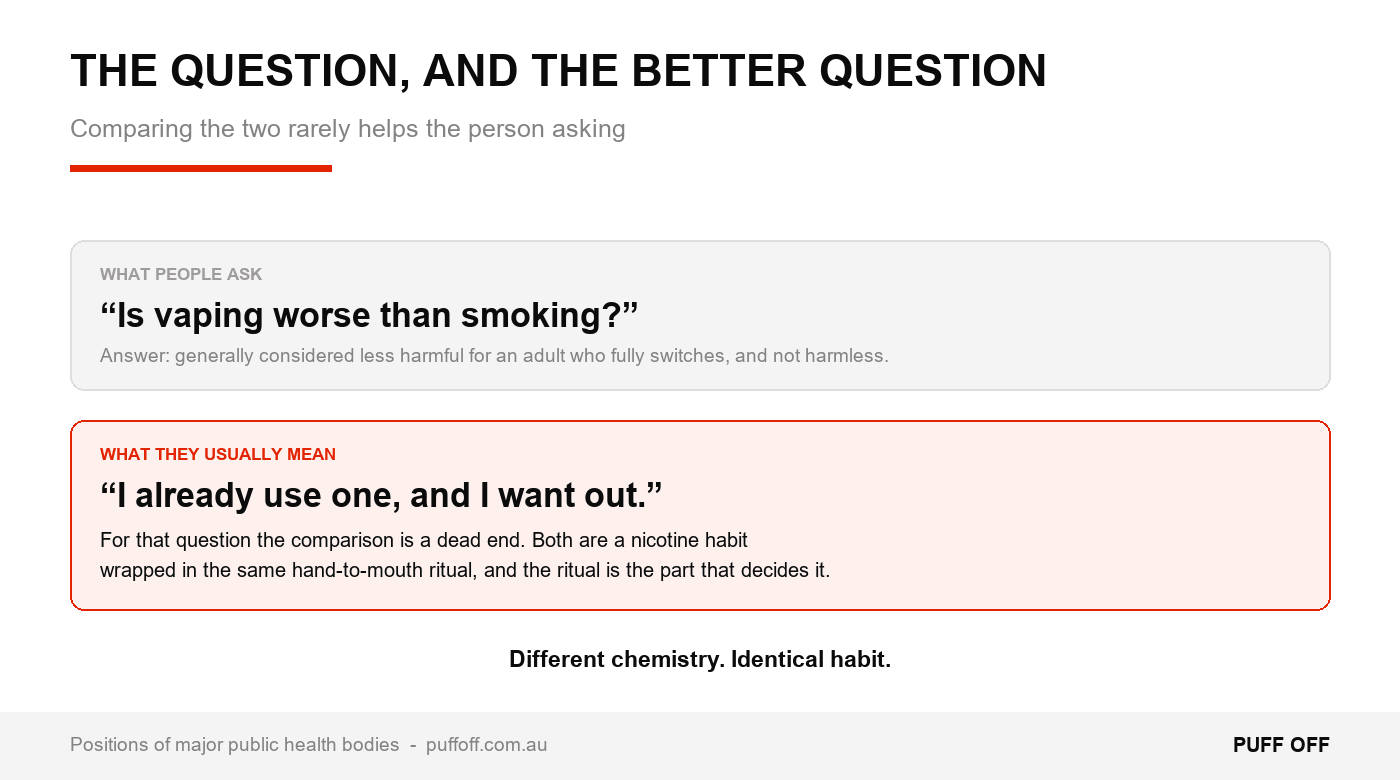
Almost nobody asking "is vaping worse than smoking" is a non-user weighing up which to take up. They are already using one. And what they usually mean is one of two things:
"Should I feel bad about switching to vaping?" If you switched from smoking to vaping, most public health positions would call that a step in a reasonable direction, while being clear it is not the destination.
"I vape and I want to stop, and I am looking for a reason that is compelling enough." This is the more common one, and the comparison does not help. Finding out vaping is somewhat better than cigarettes does not make you want to keep doing something you have already decided you want out of.
If that is you, the useful question is not which is worse. It is what actually makes stopping work.
The part that is identical either way
Whatever you are leaving, the mechanics of leaving it are the same, and this is the genuinely useful thing to know.
Both are a nicotine habit wrapped in a physical ritual. Both involve hand to mouth, an inhale, a pause, an exhale, and a set of moments in your day that have been welded to that sequence. Coffee. After eating. In the car. The step outside when work gets loud.
The chemistry differs a little in pattern. A pack-a-day smoker has around twenty discrete events. A vaper often has hundreds of small ones spread across the whole day, which means the hand-to-mouth motion has been rehearsed far more times. That is why a lot of people find the physical withdrawal from vaping milder than they feared, and the habit side harder.
We went into the mechanics of that in why the hand-to-mouth habit outlasts nicotine.
What this means practically
- If you smoke and are considering vaping to get off cigarettes, talk to a pharmacist or doctor. In Australia that is the actual pathway, and they can also walk you through nicotine replacement options.
- If you vape and want to stop, the comparison is a dead end. Plan for the first 72 hours of withdrawal and then plan for the habit, which is the part that runs for months.
- If you have never used either, the entire debate is one you get to skip.
And a note we will make plainly because it matters: Puff Off is not a health product and we make no health claims for it. It contains no nicotine, no tobacco and no vapour. It is a flavoured air inhaler aimed at the ritual, not the chemistry, and not at anything medical. If you want advice on the health side, your doctor, pharmacist or your national quitline is the right place.
FAQ
Is vaping worse than smoking?
Major health authorities generally regard vaping as less harmful than smoking for an adult smoker who switches completely, while being clear that vaping is not harmless, that long-term data is still limited, and that it is not recommended for people who do not already smoke.
Is vaping safe?
No. Less harmful than something else is not the same as safe. The long-term picture is still being studied because the products are relatively new, which is why health bodies avoid describing them as safe.
Is it easier to quit vaping or smoking?
It varies. People often report the physical withdrawal from vaping as milder, because doses are smaller and more frequent, but find the habit harder to break, because the hand-to-mouth action has been repeated many more times per day.
Does vaping help you quit smoking?
Some people use it that way and some public health bodies support it as a switching pathway for adult smokers. In Australia nicotine vapes are pharmacy-only, so this is a conversation to have with a pharmacist or doctor rather than a decision to make alone.
If I stop vaping, what should I expect?
Physical withdrawal usually peaks in the first 72 hours and eases by the end of week two. The hand-to-mouth habit lasts longer because it is behavioural rather than chemical, and it responds to replacement rather than to waiting.
Whichever one you are leaving
The chemistry differs. The ritual does not.
Get the Starter Kit - $12930-day money-back guarantee - if it's not for you, you're covered.