


How Much Money You Actually Save When You Quit Vaping
Most people who vape have never actually added it up, and there is a reason for that. It is easier to spend $15 here and $30 there than to face the yearly total. But the total is where the motivation lives, so let us do the maths properly. Fair warning: the number is bigger than you think.
This is not a lecture about wasting money. It is just the arithmetic laid out plainly, so the next time a craving tries to talk you into "just grabbing another one," you know exactly what that habit costs over a year and over five.
Key takeaways
- A common vaping spend is around $120 a month, or roughly $1,440 a year
- Over five years that is about $7,200 - a genuine chunk of money
- The savings are real cash you can see, which makes them a better motivator than health warnings for a lot of people
- Even a nicotine-free replacement usually costs a fraction of what vaping did
The real monthly number
Let us be honest about what vaping actually costs, because the "it's only a few dollars" story is how the total sneaks up on you.
Disposables are the trap here. At roughly $15 to $30 each and lasting a couple of days for a regular user, they add up fast. Even on the conservative end, a vape every two to three days lands most people somewhere around $120 a month. Heavier users spend a lot more.
Run that forward:
| Timeframe | At ~$120/month |
|---|---|
| Per week | ~$28 |
| Per month | ~$120 |
| Per year | ~$1,440 |
| Over 5 years | ~$7,200 |
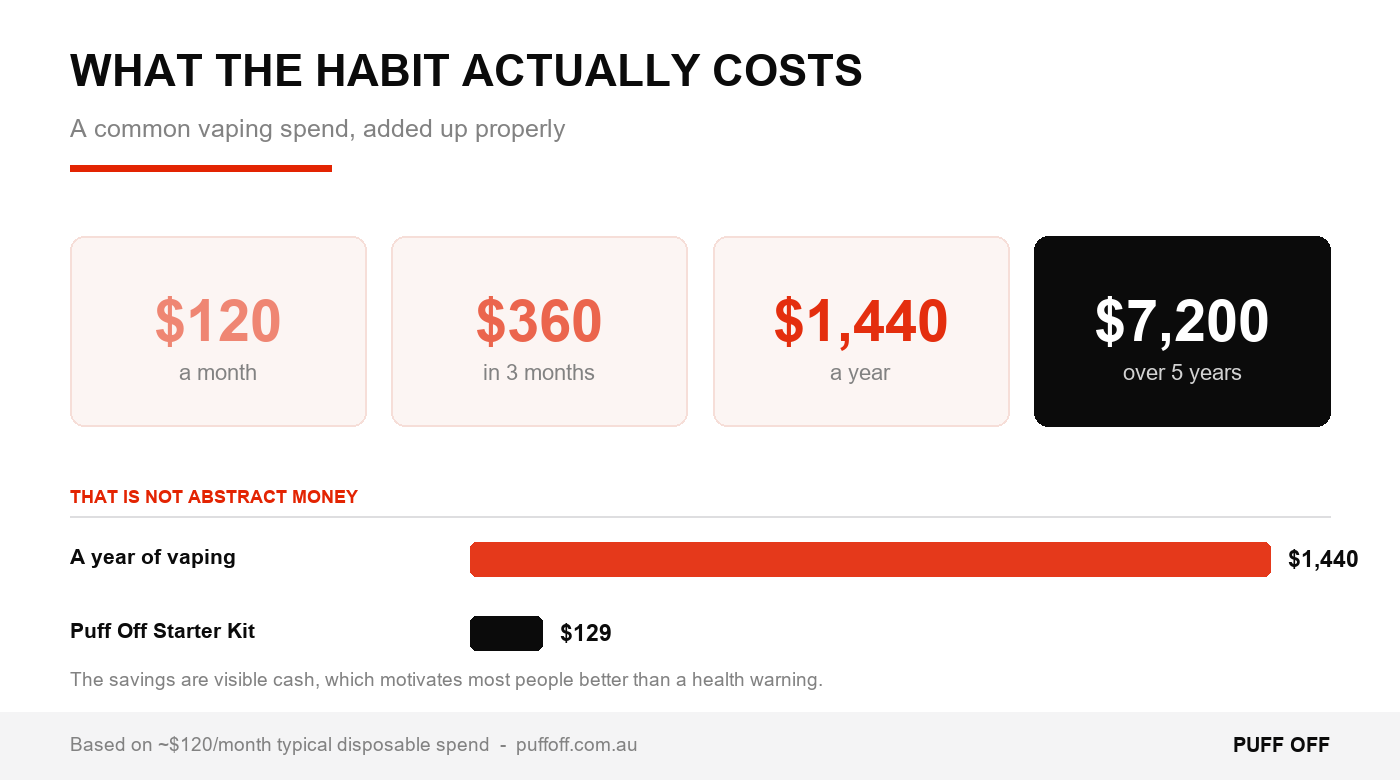
Seven thousand dollars over five years. That is a holiday, a serious dent in a loan, or a very good year of not setting fire to your money two days at a time. And that is the conservative version.
Why the number feels invisible while you are spending it
The reason vaping does not feel expensive is that it is death by a thousand small transactions. No single purchase feels like a big deal. $20 here, $25 there, tapped on a card, forgotten by the afternoon. Your brain never gets the shock of seeing the yearly figure leave your account in one go.
That is also why writing it down works so well as motivation. The moment the abstract "a few dollars" becomes a concrete "$1,440 a year," a lot of people find the cravings suddenly have to argue with a real number, and the number usually wins.
What you save even if you replace the ritual
Here is the part people miss. Quitting does not have to mean going from $120 a month to nothing while white-knuckling an empty habit. Most people do better replacing the ritual than deleting it, and even then the maths is still dramatically in your favour.
A nicotine-free flavoured air inhaler, for example, runs on flavour cores that cost a fraction of a vaping habit - roughly $29 a month on the illustrative figures we use, versus around $120 for vaping. So the comparison is not "$120 vs $0 but miserable." It is closer to this:
| Vaping | Nicotine-free replacement | |
|---|---|---|
| Per month | ~$120 | ~$29 |
| Per year | ~$1,440 | ~$348 |
| Over 5 years | ~$7,200 | ~$1,740 |
That is still around $5,460 saved over five years, and you keep the ritual instead of fighting the empty-handed feeling that sends so many people back. If the routine is your hard part, that trade is a lot easier to stick to than pure cold turkey. We ranked the options in alternatives people actually stick with.
Money is a better motivator than you think
Health warnings work for some people, but they are abstract and far away. Money is concrete and it is now. You can see it, count it, and spend it on something you actually want. For a lot of people trying to quit, the savings jar does more heavy lifting than any lung diagram ever could.
So do the sum once, honestly. Write down your real weekly spend, multiply it out, and put the yearly number somewhere you will see it. Then every craving is not just a craving. It is a small bill you get to decide whether to pay. And once you have seen the total, "just grabbing another one" never sounds quite as harmless again.
FAQ
How much does vaping cost per year?
For a regular user spending around $120 a month, mostly on disposables, that works out to roughly $1,440 a year, or about $7,200 over five years. Heavier users spend considerably more. The cost feels invisible because it comes in many small purchases rather than one big one.
How much money will I save if I quit vaping?
At a common spend of about $120 a month, you save roughly $1,440 a year. Even if you switch to a nicotine-free replacement that costs a fraction of vaping, you still save a large majority of that, on the order of $5,000 over five years on illustrative figures.
Why does vaping not feel expensive?
Because it is spread across many small transactions. No single $20 to $30 purchase feels significant, so your brain never registers the yearly total. Adding it up in one figure is exactly why writing the number down works so well as motivation.
What is the best way to stay motivated to quit vaping with money?
Start a switch jar or a separate savings account and move the money you would have spent into it every time. Seeing the pile grow turns an abstract benefit into a visible, concrete reward, which tends to motivate better than distant health warnings.
Is a nicotine-free replacement cheaper than vaping?
Generally, yes, by a wide margin. On the illustrative figures we use, cores for a nicotine-free flavoured air inhaler run around $29 a month versus roughly $120 for vaping, so you keep the ritual and still save the large majority of what you were spending.
Ready to keep the money instead? Try the Puff Off Starter Kit
Same ritual, a fraction of the cost, and no nicotine. The maths does the arguing for you.
The Puff Off Starter Kit keeps the hand-to-mouth ritual on flavour cores that cost a fraction of a vaping habit - nicotine-free, no smoke, no batteries.
Get the Starter Kit - $12930-day money-back guarantee - if it's not for you, you're covered.