


What Is Actually In a Vape? A Plain Ingredient Breakdown
Most people who vape have never read an ingredient list, partly because a lot of products do not carry a useful one. This is the plain version of what is in there, with no scare tactics and no pretending it is nothing.
Two things matter here. What goes into the liquid, and what happens when you heat it. They are separate questions and the second one is where most of the uncertainty lives.
Key takeaways
- Vape liquid is mostly four things: propylene glycol, vegetable glycerine, flavourings and often nicotine
- Those ingredients are well understood as food ingredients, which is not the same as being well understood when heated and inhaled
- Heating also introduces things that were never in the bottle, from the coil and from thermal breakdown
- The honest summary: the liquid is simple, the aerosol is the complicated part
The four main ingredients
Propylene glycol (PG). A clear, slightly sweet liquid used widely in food, cosmetics and medicines. In vape liquid it carries flavour and produces the throat hit people describe. It is a humectant, which means it holds onto water, and that is why dry mouth and a scratchy throat are the most universal complaints among people who vape.
Vegetable glycerine (VG). Thicker and slightly sweet, made from plant oils. It is what produces visible clouds. Higher VG ratios mean more vapour and a smoother draw. Also a humectant, so it contributes to the same dryness.
Flavourings. Usually food-grade flavour compounds, the same broad family used in sweets and drinks. This is the part worth reading carefully, because "food-grade" describes safety for eating, and eating and inhaling are different exposures. A flavouring being safe in a biscuit does not automatically tell you how it behaves as an inhaled aerosol.
Nicotine. Present in most products, usually as freebase nicotine or nicotine salt. Salts are smoother at higher strengths, which is why disposables often carry a lot more nicotine than people assume. In Australia, nicotine vapes have been pharmacy-only since 2024.
What heating adds
This is the part that gets skipped, and it is the more interesting half.
A coil heats the liquid to a few hundred degrees. That does two things that the ingredient list on the bottle cannot describe.
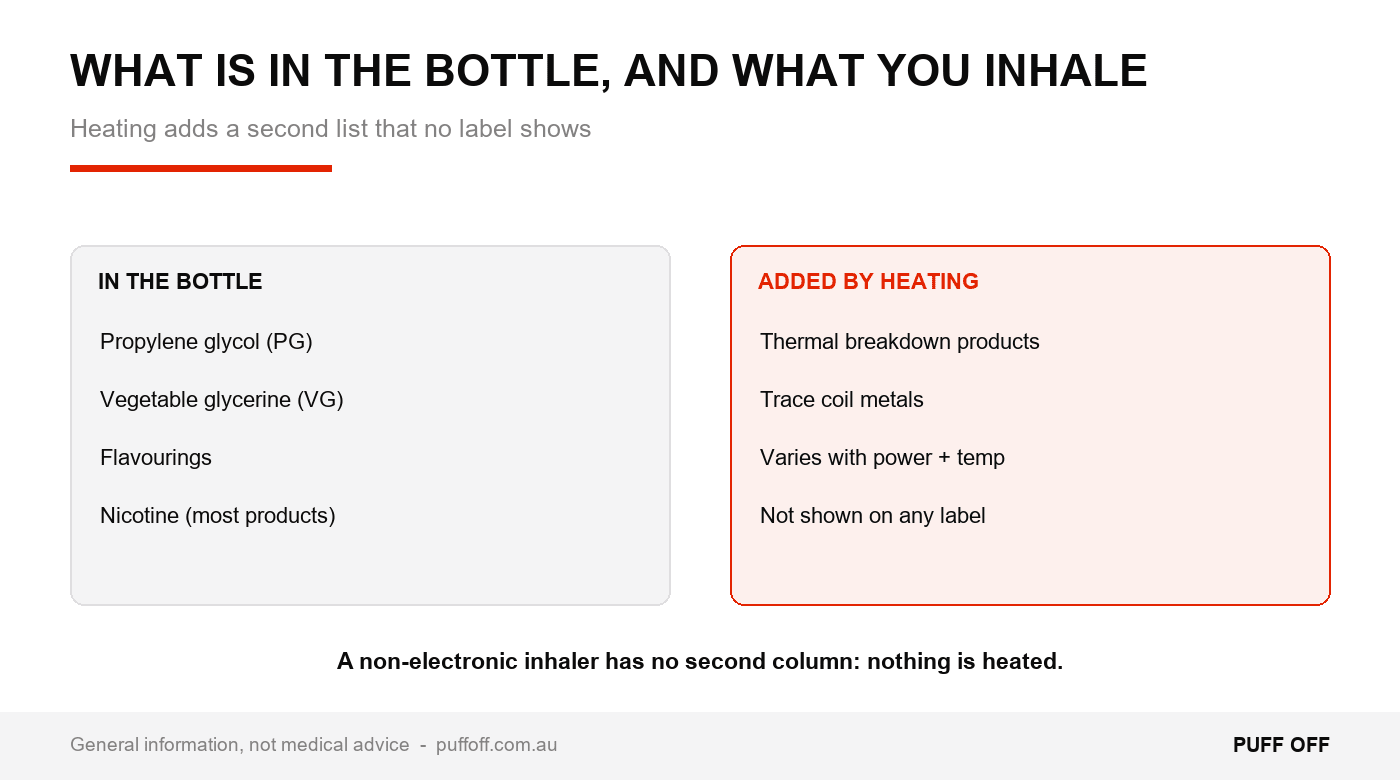
Thermal breakdown. Heating PG and VG can produce compounds that were not in the liquid to begin with. How much depends heavily on coil temperature, power settings and whether the wick is properly saturated. A device run hot or dry produces measurably different output from the same liquid run cool.
Coil material. The heating element itself is metal, and trace metals have been detected in vape aerosol in various studies. Again this varies by device, coil age and how hard it is being driven.
So the accurate statement is not "vape liquid contains X." It is "vape liquid contains X, and the aerosol you actually inhale contains X plus whatever the heating produced." Those are different lists, and only the first one appears on packaging.
Why this matters if you are trying to stop
Two practical implications.
First, the dry mouth and throat are not in your head. They are the predictable result of drawing humectants across your mouth and throat repeatedly. That symptom typically eases within a couple of weeks of stopping.
Second, "food-grade" is a weaker reassurance than it sounds. It is a real standard and it means something, but it certifies safety for eating. Any product telling you that ingredients are food-grade is answering a question about ingestion, not inhalation. That applies to vape liquid, and in fairness it applies to us too, which is why we are specific about it below.
Where a non-electronic inhaler differs
Since we sell one, here is the precise version rather than a sales pitch.
Puff Off flavour cores contain food-grade flavour ingredients, supported by safety and compliance documentation, and the products contain no nicotine, tobacco, THC or CBD. The device is non-electronic: no battery, no coil, no heating element.
The relevant difference is the second half of this article. Because nothing is heated, there is no thermal breakdown step and no coil in the airflow path. It works by passive airflow, so it does not generate vapour, smoke or aerosol. That removes the category of unknowns that comes from heating, which is a narrower and more defensible claim than saying it is safe.
We are not a medicine and we make no health claims. If you want the documentation, it is on the safety and compliance page.
FAQ
What are the main ingredients in a vape?
Usually four: propylene glycol, vegetable glycerine, flavourings, and in most products nicotine. The ratios vary by product, with higher vegetable glycerine producing more visible vapour.
Is propylene glycol safe?
It is widely used in food, cosmetics and medicines and is well studied for those uses. The open question with vaping is not the ingredient itself but what happens when it is heated and inhaled, which is a different exposure from eating it.
What does heating add to vape aerosol?
Heating can cause thermal breakdown of the liquid into compounds not present in the bottle, and trace metals from the coil have been detected in aerosol in various studies. Output varies with device power, coil condition and temperature.
Does "food-grade" mean a flavouring is safe to inhale?
No. Food-grade certifies suitability for eating. Inhalation is a different route of exposure, and a flavouring being safe in food does not by itself establish how it behaves as an inhaled aerosol.
Do nicotine-free vapes still contain propylene glycol?
Generally yes. Removing nicotine does not change the carrier liquid or the fact that it is heated. A non-electronic inhaler is different because nothing is heated or aerosolised at all.
Nothing heated, nothing aerosolised
No battery, no coil, no liquid. Food-grade flavour and passive airflow.
Get the Starter Kit - $12930-day money-back guarantee - if it's not for you, you're covered.