


Replacing the Habit: What to Actually Put in Its Place
Most quit advice is subtraction. Stop doing the thing. Throw it out. Get through it.
Subtraction works for some people. For a lot of people it leaves a hole in the day where something used to sit, and the hole is what eventually pulls them back. Not the nicotine, not a craving in the pharmacological sense, just a moment that used to have a shape and now does not.
This is about what goes in the hole.
Key takeaways
- A habit is a loop: a cue, a routine, a payoff. Removal takes out the routine and leaves the other two
- The cue does not disappear. Coffee still happens. Stress still happens. 5pm still arrives
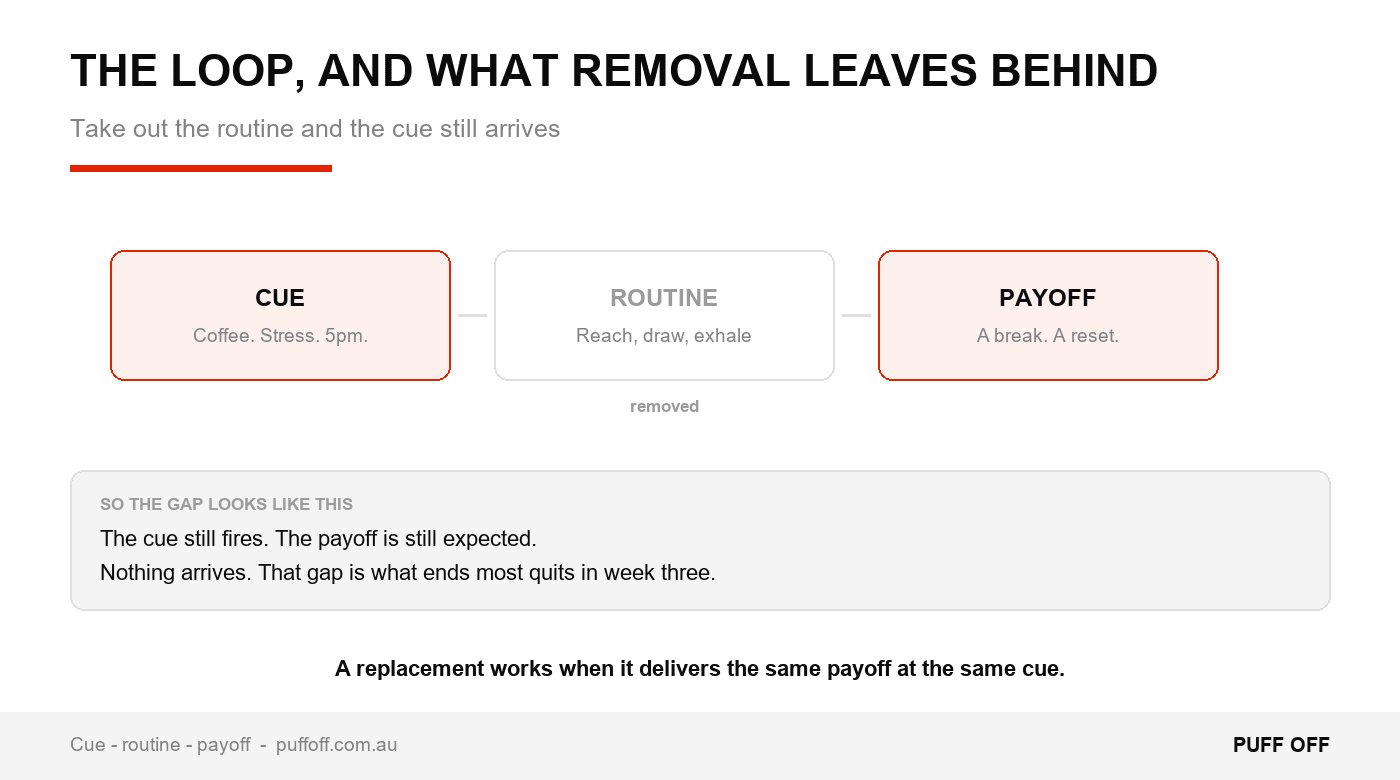
- A replacement works when it delivers the same payoff at the same cue
- Most replacements fail because they are chosen for what they are, not for which job they do
Why removal alone struggles
A habit runs as a loop with three parts.
The cue. The thing that starts it. Finishing a meal. Getting in the car. A difficult email. Walking out of the office.
The routine. The behaviour itself. Reach, draw, pause, exhale.
The payoff. What your brain got out of it. Usually some combination of a break, a reset, a moment of not-doing-the-other-thing, and something to do with your hands.
When you quit by subtraction, you remove the middle part and leave the cue and the payoff-shaped expectation untouched. The email still lands. Your body still expects the break. Nothing arrives.
That gap is what people describe as feeling restless, twitchy, or like something is missing at 9pm, and it is often the thing that ends a quit in week three rather than week one.
Work out which job it was doing
This is the step people skip, and it is the one that decides whether a replacement works.
Vaping does several jobs at once, and yours is probably not doing all of them. Over the next two days, notice which of these is actually true for you:
- The break. It was permission to stop working for four minutes.
- The hands. It gave them something to do, particularly when you were anxious or bored.
- The exhale. The long out-breath your body reads as a downshift.
- The flavour. A small sensory event in an otherwise flat afternoon.
- The social. A reason to step outside with people, or a reason to step outside alone.
- The transition. A marker between work and home, or between tasks.
Most people find two or three are doing the heavy lifting. Those are what a replacement has to cover.
Match the replacement to the job
Once you know the job, the choice is obvious rather than guesswork.
| If it was doing this | A replacement that fits |
|---|---|
| The break | Step outside anyway, without the vape. Two minutes, same spot |
| The hands | Something physical within reach. Fidget object, a pen, a device to hold |
| The exhale | Slow breathing. Four in, hold, six out. Free and genuinely effective |
| The flavour | Something with taste. Mints, tea, flavoured air |
| The social | Keep going out with them. Removing yourself is a second loss |
| The transition | A different marker. Change clothes, a walk around the block, one song |
The common mistake is choosing a replacement for the wrong job. Gum is excellent for flavour and useless for the exhale. A stress ball covers the hands and does nothing for the break. If your main job was "permission to stop working", no object solves that and you need to keep taking the break.
Give it somewhere to land, physically
One practical detail that matters more than the choice itself.
The gap between an urge and acting on it is a few seconds. A replacement in a drawer upstairs is not a replacement. Whatever you pick has to live where the vape lived: same pocket, same bedside table, same cupholder.
This is the most common reason a perfectly sensible replacement fails. Not that it was wrong, just that it was not there.
Where our product sits in this
Since we sell one, here is the honest placement rather than a pitch.
Puff Off covers a specific combination of jobs: the hands, the flavour, and the full physical sequence of reach, draw, pause and exhale. It is a wooden, non-electronic inhaler with food-grade flavour cores, containing no nicotine, tobacco, THC or CBD, with no battery, coil or heating element.
It does not cover the break, the social or the transition, because no object does. It does nothing for nicotine withdrawal, because it contains no nicotine. And it is not a medicine, so we make no health claims for it.
If the jobs on your list are mostly hands-and-mouth, it fits well. If your list is mostly "I needed permission to stop working", the honest answer is that you need to keep taking the break, and no purchase substitutes for that.
FAQ
How do I replace the vaping habit with something else?
Work out which job vaping was doing for you, then choose a replacement that delivers the same payoff at the same cue. Most people find two or three jobs dominate, commonly the hands, the exhale and the break.
Why does quitting leave me feeling like something is missing?
Because a habit is a loop of cue, routine and payoff. Removing the routine leaves the cue and the expectation of a payoff intact, so the moment still arrives with nothing in it. That gap is what a replacement fills.
What can I do instead of vaping?
Depends which job it was doing. For the hands, something physical within reach. For the exhale, slow breathing. For the flavour, mints, tea or flavoured air. For the break, keep taking the break without the vape.
Should I change my routine to avoid triggers?
Changing the cue and the routine at once is two habit changes at the same time and is much harder. It usually works better to keep the cue, such as still stepping outside after lunch, and change only what you do in that moment.
How long until the habit stops pulling at me?
Habit research puts new automatic behaviours at roughly 66 days on average, with wide variation. Nicotine withdrawal is largely done in two to three weeks, so anything that persists past that is the habit rather than the chemistry.
If the job was your hands and your mouth
That is the combination this was built for.
Get the Starter Kit - $12930-day money-back guarantee - if it's not for you, you're covered.