


10 Reasons to Quit Vaping That Are Not About Fear
You already know the health argument. Everyone does. If being told it is bad for you was going to work, it would have worked by now.
So this list is the other thing: the reasons people actually give when you ask them why they finally stopped. Some are small. The small ones tend to be the ones that stick.
Key takeaways
- Fear-based reasons rarely hold, because the fear fades and the habit does not
- The reasons that last are usually about autonomy, money and sleep
- Most people who stop successfully have two or three reasons, not one big one
- The reason that works is the one you believe, not the one you are supposed to say
1. You are tired of needing it
The most common reason, and almost never the one people lead with. It is not about health. It is the low-level irritation of noticing you have checked three times whether it is in your pocket. Wanting something is fine. Needing it grates.
2. The money is genuinely absurd once you write it down
Nobody feels a $20 purchase. Everybody feels the yearly total. Regular users commonly land somewhere between $700 and $1,800 a year depending on country and habit. Write your own figure on paper. It is usually the single most motivating sentence in the process.
3. Sleep
Nicotine is a stimulant with a half-life of around two hours. Evening use delays sleep onset, and levels dropping overnight cause waking. If you reach for it within a minute of opening your eyes, your night included mild withdrawal. People consistently report sleep as the first thing that improves.
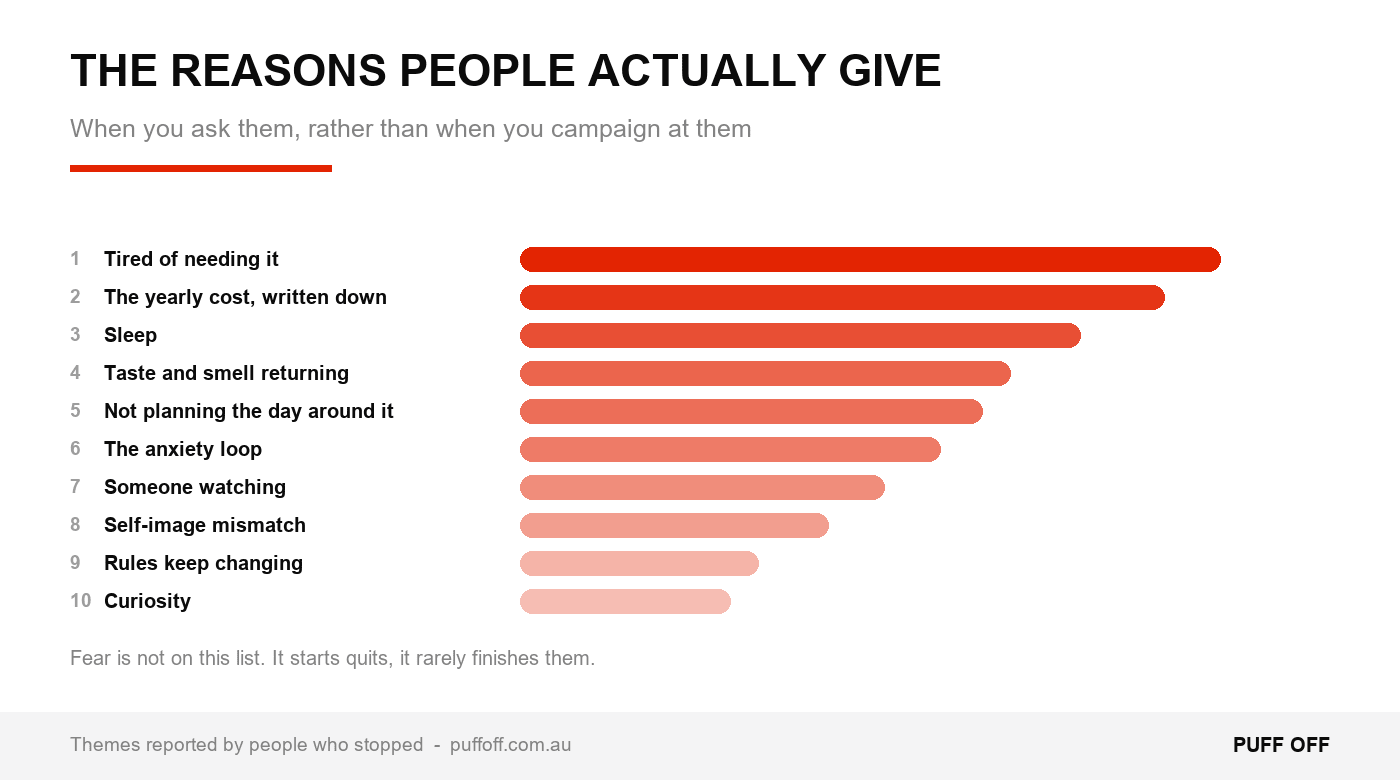
4. Taste and smell come back
The change people mention most fondly and expect least. Food gets more interesting within a couple of weeks. It is a small, daily, undeniable win, which is exactly what makes it useful early on.
5. You stop planning your day around it
Charging it. Checking the level. Working out whether you can get through a flight, a dinner, a long meeting. It is a background process running constantly, and you only notice how much space it took up once it stops.
6. The anxiety loop
Many people describe vaping as calming. The mechanism is usually that nicotine creates a small withdrawal about every hour and then relieves it, so the relief reads as calm. People frequently report settling below their previous baseline a few weeks after stopping. We set out why in why anxiety spikes when you quit.
7. Someone is watching
Kids, a partner, a younger sibling. Not guilt exactly, more the discomfort of explaining something you cannot defend. It is a legitimate reason and it motivates a lot of people.
8. You do not like what it says about you
Not shame, just a mismatch. People who see themselves as reasonably disciplined find it grating to be led around by a small plastic object. That gap between self-image and behaviour is a strong and underrated motivator.
9. The rules keep changing
Australia moved to pharmacy-only in 2024. The UK banned disposables in 2025. Supply, price and legality keep shifting, and being dependent on something whose availability is politically decided is uncomfortable in itself.
10. You want to find out who you are without it
The quietest reason and often the most durable. Not fear, not money, just curiosity about what daily life feels like when nothing is being managed. People who quit for this one tend not to relapse, because there is nothing to go back to.
The one thing no reason fixes
Worth saying, because it is where most attempts come apart.
A good reason gets you started. It does not do anything about the hand-to-mouth habit, which is a motor pattern rehearsed tens of thousands of times and which does not care about your reasons.
That is why people with excellent, sincere reasons still find themselves reaching at 9pm three weeks in. The reason is not failing. It was never the tool for that job. You need a reason and a replacement, and most people only bring the first one.
FAQ
What is the best reason to quit vaping?
The one you personally believe. Research and experience both suggest self-chosen reasons hold up better than externally supplied ones, which is why fear-based campaigns tend to underperform reasons like money, sleep and autonomy.
What happens to your body when you quit vaping?
People commonly report better sleep within a couple of weeks, taste and smell returning, steadier energy as the stimulant cycle stops, and anxiety settling after an initial spike. Withdrawal symptoms peak in the first 72 hours and largely ease by the end of week two.
How long does it take to feel better after quitting vaping?
Most people describe a clear improvement by the end of week two, with the hardest stretch being the first three days. Taste, smell and sleep are usually the earliest noticeable changes.
Is it worth quitting vaping if I only vape a little?
Light users often find the chemical side easy and the habit side surprisingly persistent, since the reach is built by repetition rather than dose. Many report the main gain is not health but no longer organising their day around it.
Why do I keep relapsing even though I have good reasons?
Because reasons address motivation and relapse is usually behavioural. The hand-to-mouth habit outlasts withdrawal, so a strong reason with no replacement leaves the automatic motion with nothing to do.
Bring a replacement, not just a reason
Your reasons get you to day one. Something for your hands gets you to day thirty.
Get the Starter Kit - $12930-day money-back guarantee - if it's not for you, you're covered.