


Quit Vaping Apps and Trackers: What They Fix and What They Do Not
There are a lot of these, they mostly do the same four things, and they are genuinely useful for one part of quitting and completely useless for another. Knowing which is which will save you from concluding that "apps do not work" when really you asked one to do a job it was never built for.
Key takeaways
- Apps are strong at motivation, tracking and milestones across weeks
- They are weak at the sixty seconds a craving actually lasts
- The best use is as a record, not as a coping tool
- An app plus a physical replacement covers far more ground than either alone
What they actually do
Nearly every quit tracker offers the same four features, whatever the branding.
Streak counters. Days since you stopped. Simple and surprisingly effective, because a visible streak becomes something you do not want to break.
Money saved. Your spend, multiplied by elapsed time. This is the feature people screenshot, and the one most likely to be shown to a friend.
Health milestones. Notifications at intervals. Treat these as encouragement rather than as personalised medical information, since they are generic timelines rather than anything measured about you.
Craving logs. You record each craving, its strength and its trigger. The least used feature and quietly the most valuable, for reasons below.
What they are genuinely good at
Making progress visible. Quitting is mostly an absence, and absences are hard to feel good about. A counter converts nothing-happening into something-accumulating.
Getting you through weeks two to eight. This is the stretch where motivation fades but the habit has not, and where most people quietly stop trying. A streak you do not want to break is a real force here.
Pattern spotting. If you log cravings for a week, you will find your triggers are not random. Almost everyone has three specific situations doing most of the damage. Knowing which three lets you plan for them instead of bracing all day.
The gap
Here is the honest limitation.
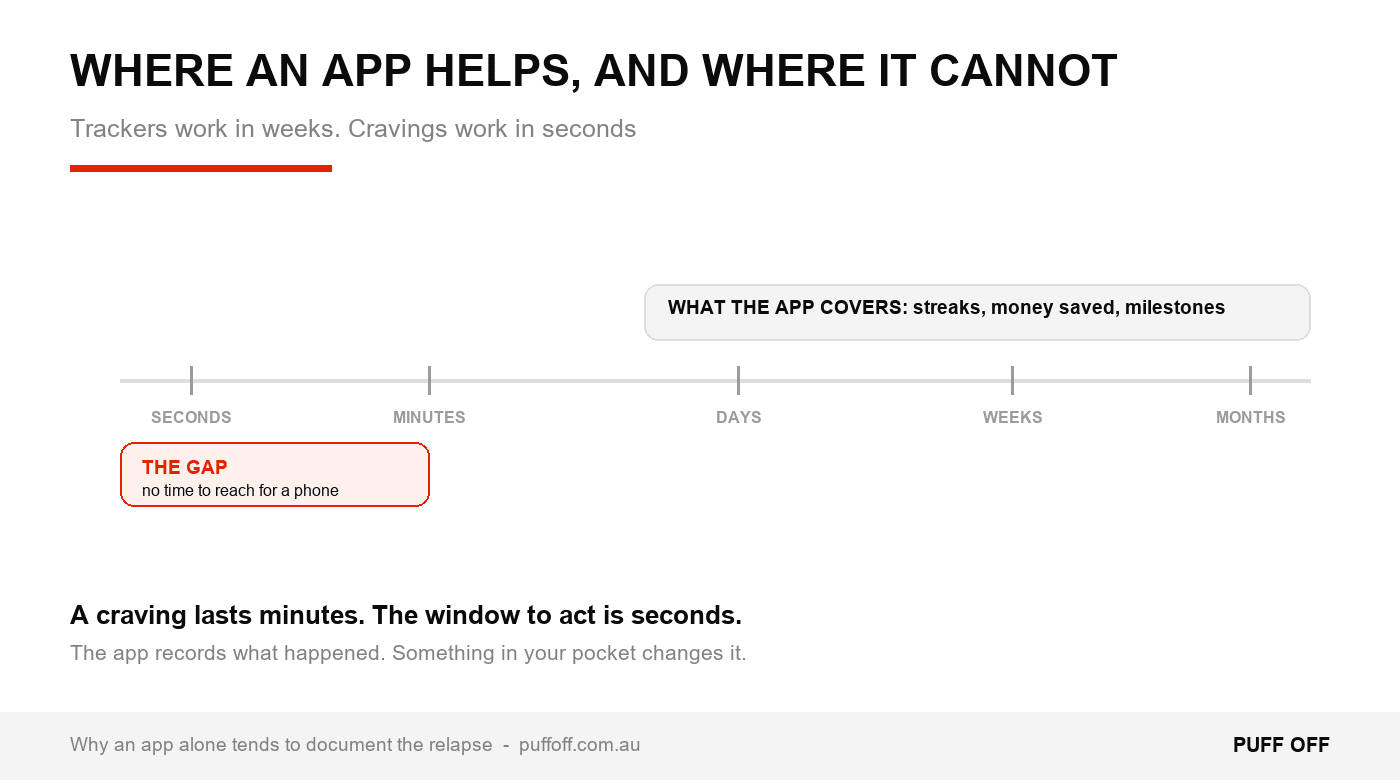
A craving lasts a few minutes. The window between the urge and acting on it is a few seconds. In that window you do not open an app. Nobody has ever been talked out of a craving by a notification.
Apps operate on the scale of days and weeks. Cravings operate on the scale of seconds. That mismatch is the whole problem, and it is why people who rely on an app alone tend to have great data about exactly how they relapsed.
The thing that works in that window is physical and within reach. Water, a walk, ten slow breaths, something for your hands. The app records what happened. It does not intervene.
How to use one properly
- Pick one and stay with it. Switching apps resets your streak, which is the main feature.
- Turn off health milestone notifications if they feel hollow. Generic claims about your body at hour 48 can read as noise and undermine the app's credibility with you.
- Log cravings for the first week only. Get your three triggers, then stop.
- Look at money saved weekly, not daily. Daily increments are too small to feel.
- Pair it with something physical. The app handles weeks. Something in your pocket handles seconds.
The combination that works
For most people it is three things, and they cover different timescales.
A reason you actually believe, which handles the decision. An app, which handles the weeks. A physical replacement, which handles the seconds.
Bring only the first two and you will have a well-documented account of reaching for a vape at 9pm on day nineteen. We wrote about why that specific moment beats people in what to do with your hands and mouth.
FAQ
Do quit vaping apps work?
They work for motivation, tracking and getting through the middle weeks, which is a real contribution. They do not help in the moment a craving hits, because that window is seconds long and apps operate on days and weeks.
What is the best quit vaping app?
Most offer the same four features, so the practical answer is whichever one you will actually keep open. Consistency matters more than features, since switching apps resets the streak that does most of the work.
Are the health milestones in quit apps accurate?
They are generic timelines rather than anything measured about you, so treat them as encouragement rather than personal medical information. For anything specific about your health, ask a doctor.
What should I use instead of an app when a craving hits?
Something physical and within reach. Water, ten slow breaths, two minutes of movement, or something for your hands and mouth. Cravings pass in minutes if you give them room, and the response has to be faster than unlocking a phone.
Is tracking money saved actually motivating?
For many people it is the most motivating feature, because it converts an absence into a visible number. Check it weekly rather than daily, since daily increments are too small to register.
For the seconds an app cannot cover
Track the weeks with an app. Cover the moment with something you can hold.
Get the Starter Kit - $12930-day money-back guarantee - if it's not for you, you're covered.