


Oral Fixation: Why Your Mouth Misses It More Than Your Body Does
A few weeks after stopping, most people hit the same strange moment. The headaches are gone. The temper is back to normal. You are sleeping again. And you are standing in the kitchen at 9pm feeling like something is missing, with your hand halfway to your face before you have decided anything.
That is oral fixation, and it is the single most under-planned part of quitting.
Key takeaways
- Oral fixation is a behavioural loop, not a chemical need, which is why it outlasts withdrawal
- It attaches to specific moments: after eating, with coffee, in the car, at the end of the day
- Replacements that only cover the mouth or only cover the hands tend to feel unfinished
- What satisfies it is the whole sequence: reach, draw, flavour, pause, exhale
What it actually is
"Oral fixation" gets thrown around loosely. Practically, it describes a learned association between your mouth and a set of situations, built by repetition until it runs without conscious input.
A pack-a-day smoker performs the hand-to-mouth motion roughly 200 times a day. A regular vaper often does it far more, because there is no natural stopping point where the cigarette runs out. Multiply that across a year and you get a movement your nervous system has practised tens of thousands of times.
Your brain files repeated sequences as procedural memory, the same category as typing or driving. That is efficient, and it is also why the motion continues after the reason for it is gone. Procedural memory does not check whether you still want the outcome.
Why it outlasts the nicotine
Nicotine clears in days. The chemistry of withdrawal peaks in the first 72 hours and is largely finished within two to three weeks.
The habit is on a completely different clock. Research on habit formation puts the average at around 66 days to establish a new automatic behaviour, with a wide range depending on the person and the behaviour. Unlearning one that has been rehearsed for years is not faster.
So the common experience makes sense: physically fine, mentally clear, and still reaching. That is not relapse and it is not weakness. It is a motor pattern with nothing to do.
Why most replacements disappoint
This is the part worth understanding before you spend money on things that end up in a drawer.
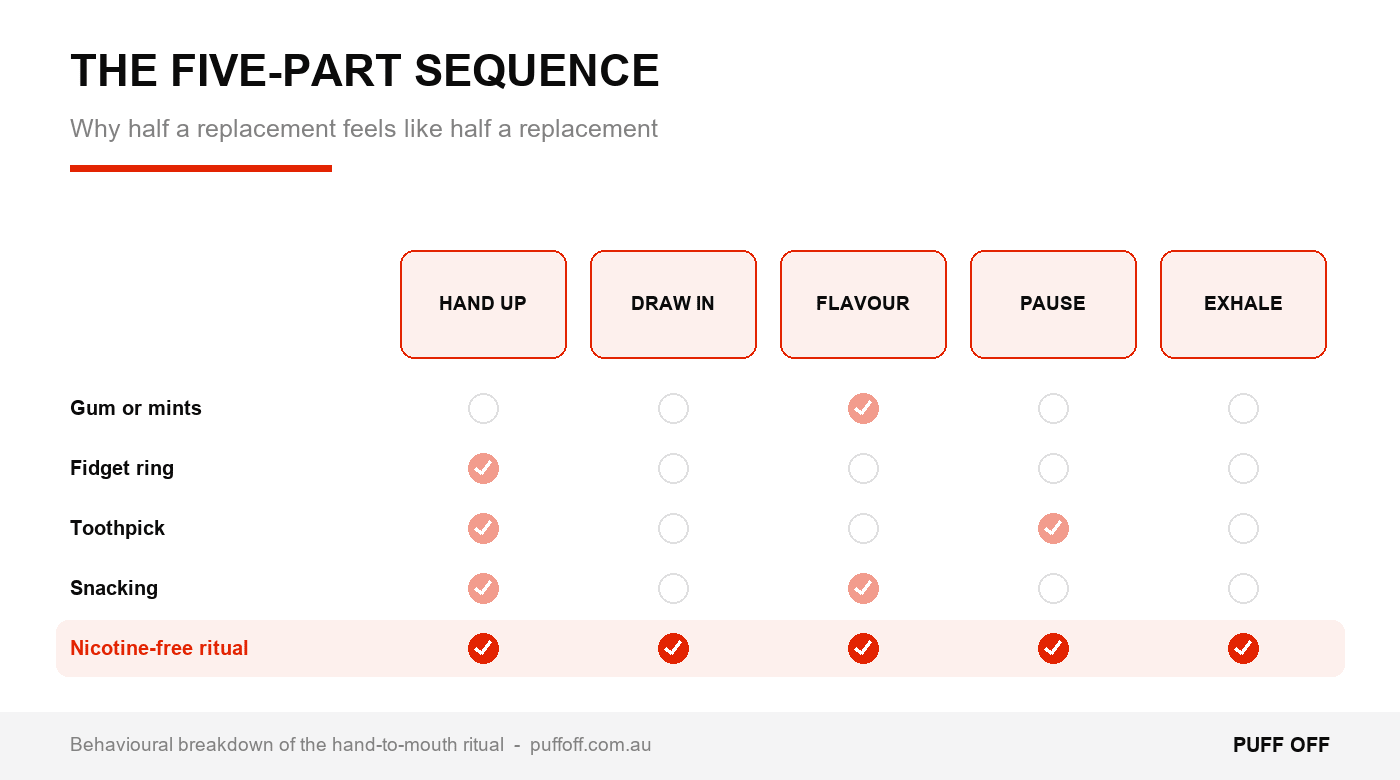
The full sequence has five parts. Hand up. Draw in. Flavour. Pause. Exhale.
- Gum, mints, lozenges. Cover flavour and give the mouth a job. No reach, no inhale, no exhale. Helps, but a lot of people describe it as not quite scratching it.
- Stress balls, fidget rings, spinners. Cover the hands. Mouth is untouched. Same problem in reverse.
- Toothpicks, straws, cinnamon sticks. Cover the mouth and part of the hand motion. No flavour on the draw, no real exhale.
- Snacking. Covers mouth and flavour, and is the reason weight gain shows up so often. Also gives no exhale, which is the part that reads as a break.
The pattern is consistent: partial coverage feels partial. When people say a replacement "did not do it for me," they are usually describing a sequence that stopped halfway through.
We wrote a longer version of this with the full comparison in what to do with your hands and mouth.
What actually satisfies it
Whatever you choose, two things matter more than which option you pick.
It has to cover the whole sequence. Hand up, draw, flavour, pause, exhale. Anything that covers two of five will feel like it is missing something, because it is.
It has to be within arm's reach. The gap between craving and action is a few seconds. A replacement in a drawer upstairs is not a replacement. This is the most common reason a perfectly good option fails.
This is the specific gap Puff Off was built for. It is a wooden, non-electronic inhaler with flavour cores. No nicotine, no tobacco, no vapour, no batteries. You reach, you draw, you get flavour, you exhale. The sequence completes, and the motor pattern has somewhere to land while it fades.
It is not a medicine and we make no health claims for it. It is a ritual replacement, which is exactly the problem oral fixation is.
FAQ
What is oral fixation when quitting smoking or vaping?
It is a learned association between your mouth and specific situations, built by repeating the hand-to-mouth motion thousands of times. It is behavioural rather than chemical, which is why it continues after nicotine withdrawal has finished.
How long does oral fixation last after quitting?
Longer than withdrawal. Nicotine clears within days and withdrawal largely resolves in two to three weeks, while habit research suggests new automatic behaviours take around 66 days on average to form. It fades with replacement and repetition rather than with time alone.
Why does gum not fully satisfy the urge?
Gum covers flavour and gives your mouth something to do, but not the reach, the inhale or the exhale. The full ritual is a five-part sequence, and replacements that cover only part of it tend to feel unfinished.
Does oral fixation cause weight gain when quitting?
It contributes. Snacking covers the mouth and flavour parts of the sequence, so it is the replacement people fall into by default. Having a non-food option available makes that pattern less automatic.
What is the best replacement for the hand-to-mouth habit?
The one that covers the whole sequence and is physically within reach when the urge hits. Whether that is a nicotine-free inhaler, a toothpick or a glass of water matters less than whether it completes the motion and is actually there.
Give the reach somewhere to land
You are not fighting a craving. You are missing a sequence.
Get the Starter Kit - $12930-day money-back guarantee - if it's not for you, you're covered.