


How to Help Someone Quit Vaping or Smoking (Without Making It Worse)
Watching someone you care about struggle with this is its own kind of frustrating, particularly when the thing that would obviously work seems so simple from the outside.
The awkward truth is that most instinctive helping behaviour makes it harder. Not because your instincts are bad, but because quitting is a control problem, and most help reads as taking control away.
Key takeaways
- The single most useful thing is asking "what would actually help?" rather than deciding for them
- Nagging, ultimatums and hiding their stuff consistently backfire, and the research on this is not subtle
- Practical support beats emotional pressure: cover the trigger moments, do not supervise
- If they slip, how you react in the next sixty seconds matters more than anything else you do
Start with one question
Before doing anything, ask: "What would actually help, and what would drive you mad?"
Then believe the answer. People generally know which kind of support they want, and it varies enormously. Some want accountability and check-ins. Some want the whole thing not mentioned. Both are legitimate, and guessing wrong is where most well-meant help goes wrong.
If you take one thing from this article, take that question.
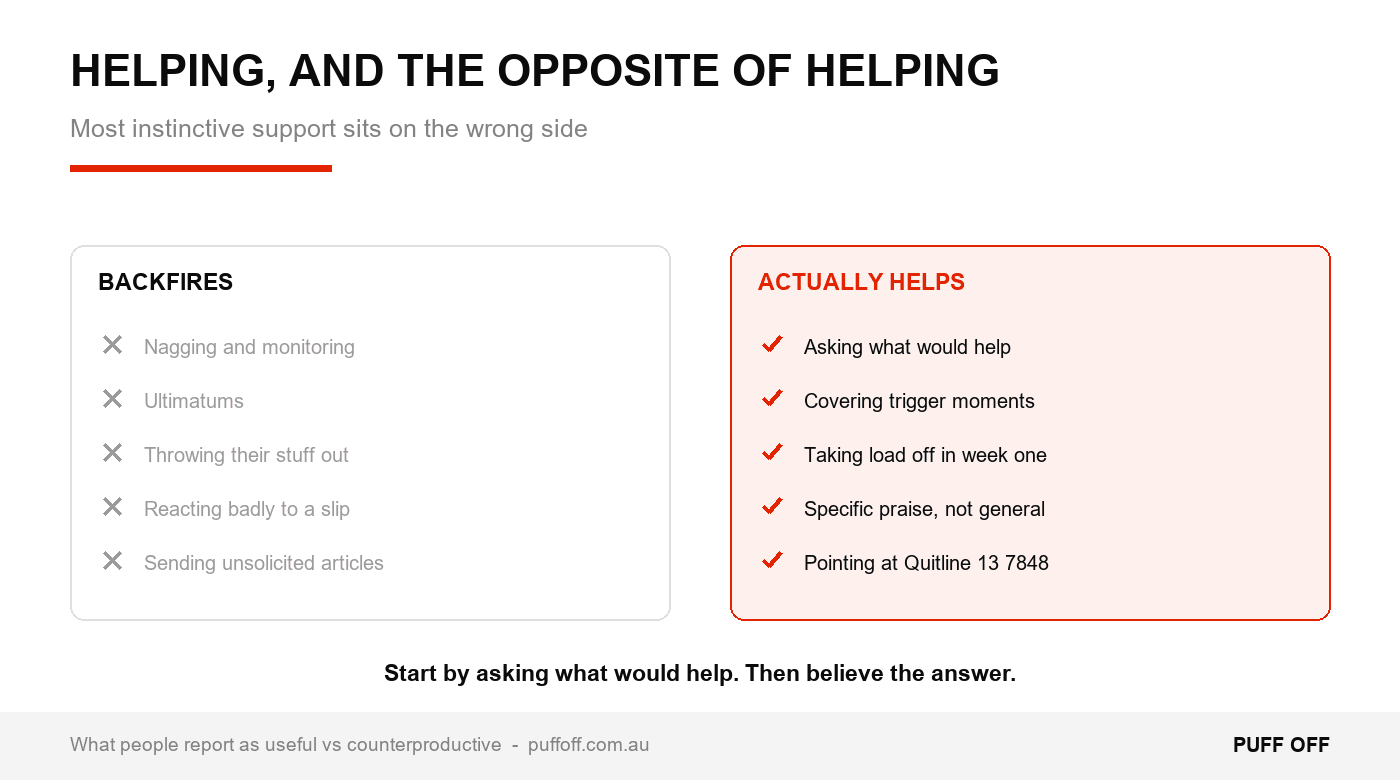
What reliably backfires
Nagging and monitoring. Counting how many times they have used it today. Asking every evening how it is going. This turns their quit into your project, and the predictable response is concealment rather than compliance.
Ultimatums. "It's me or the vape." Occasionally this works and mostly it adds a large emotional weight to a process that already has enough. It also makes a slip feel like a betrayal rather than a stumble, which makes them more likely to hide it and less likely to restart.
Throwing their stuff out. Satisfying, and it removes a decision they needed to make themselves. Quitting sticks better when the person chooses it. If they ask you to get rid of it, that is different, and worth doing immediately.
Reacting badly to a slip. More on this below, because it is the highest-leverage moment.
Sending them articles. Including this one, if it arrives unsolicited as a hint. It reads as pressure wearing a helpful hat.
What actually helps
Cover the trigger moments. Almost everyone has three specific situations where it is hardest, usually after meals, with coffee, and one point in the evening. Suggest a walk after dinner. Change what happens at the moment rather than talking about the habit in the abstract.
Take something off their plate during week one. Withdrawal peaks in the first 72 hours and it makes people foggy, irritable and short-fused. Handling dinner or the kids for a few days is more useful than any amount of encouragement.
Do not take the irritability personally. Days two to four are genuinely rough and it is chemistry rather than character. Knowing that in advance helps both of you.
Be specific with praise. "You got through the whole barbecue" beats "proud of you". Specific recognition of a hard moment lands as real; general praise can feel like being managed.
Point at the free stuff. In Australia, Quitline on 13 7848 is free telephone coaching and it is consistently under-used. A pharmacist consultation also costs nothing and can sort out nicotine replacement dose, which is where most attempts quietly fail.
Ask what they are doing about their hands. This is the practical gap most quit plans miss. Nicotine withdrawal resolves in two to three weeks. The hand-to-mouth habit runs for months, and it is what people are usually fighting at week five when everyone has stopped asking how they are going.
The moment that matters most
If they slip, the next sixty seconds do more work than everything else combined.
The instinct is disappointment, and even a well-controlled version of it is legible. What that teaches is that slipping has a social cost, so the next slip gets hidden. Hidden slips are how a single cigarette becomes a quiet return over three weeks.
The more useful response is boring: "Okay. What happened just before?"
That treats it as information rather than failure, which is also what it actually is. One slip does not undo the progress, and what determines the outcome is how fast they resume, not whether they were perfect. We wrote about that pattern in how to break the vape routine.
If they have not decided to quit yet
Hardest situation, and the honest answer is that you cannot want it for them.
What you can do is say once, calmly and without a follow-up campaign, that you would support them if they ever wanted to stop, and that the offer stands. Then leave it. Repeating it converts a standing offer into background pressure, and pressure produces defensiveness rather than decisions.
People move on their own timeline. The thing that gets them there is usually not persuasion, it is the moment they get sick of needing it.
FAQ
How can I help someone quit vaping?
Ask what kind of support they want rather than deciding for them, help cover their trigger moments practically, take pressure off during the first week, and react to any slip with curiosity rather than disappointment.
Does nagging someone to quit work?
Generally no. Monitoring and repeated reminders tend to produce concealment rather than change, because they turn the person's quit into someone else's project and make slips feel like betrayals.
Should I throw away their vapes or cigarettes?
Not unless they ask you to. Removing it for them takes away a decision that quitting depends on them making. If they do ask, act on it straight away.
What do I say when they slip?
Something neutral and practical, such as "okay, what happened just before?" A slip is information about a trigger, not a failure. What matters is how quickly they resume, not whether they were perfect.
Where can someone get free help to quit in Australia?
Quitline on 13 7848 offers free telephone coaching and callback programs. A pharmacist consultation is also free and can advise on nicotine replacement options and dose.
For the part that outlasts the first fortnight
Withdrawal fades in a couple of weeks. The reaching does not, and that is usually what beats people later.
Get the Starter Kit - $12930-day money-back guarantee - if it's not for you, you're covered.