


How I Quit Vaping: 28 Years, Two Habits, One Thing That Finally Worked
Most quit stories are written by people who quit six weeks ago. This one is from Sam, who founded Puff Off after spending 28 years reaching for the same thing: 20 years of cigarettes, then 8 more of vaping.
We are telling it because the useful part is not the willpower. It is the specific mistake he kept making, which is the same one most people make.
Key takeaways
- Switching from cigarettes to vaping changed the device, not the loop
- Cold turkey lasted days at a time, repeatedly. Not a character problem, a planning one
- Patches and gum handled the nicotine and left the reaching completely unaddressed
- The turning point was realising the habit had two layers and he had only ever treated one
Twenty years, then eight more
Sam started smoking young and kept at it for two decades. When vapes arrived they looked like the exit, so he switched. That is a genuinely reasonable move and a lot of people made it.
What he found was that almost nothing changed. Same morning coffee, same drive to work, same stressful afternoons, same wind-down at night. Different object in his hand. The device had changed and the loop had not.
If anything, vaping was stickier. A cigarette ends. It burns down, you put it out, there is a natural full stop. A vape has no full stop, so the hand-to-mouth motion went from roughly twenty deliberate events a day to a few hundred small automatic ones. After 28 years, the reach had become part of how his hands worked.
What did not work
Cold turkey. Lasted a few days at a time, more than once. The pattern was always similar: fine on adrenaline for two days, wrecked by day three, back to it inside a week. That is not a willpower failure, it is what happens when withdrawal peaks and your self-control is already spent. We wrote about that specific collapse point in getting past the day 3 wall.
Patches and gum. These did their job. Nicotine replacement is well studied and it genuinely reduces withdrawal. The problem was that it was aimed at the chemistry, and by week three the chemistry was not the thing pulling him back.
What was pulling him back was standing outside with nothing to hold. The inhale. The pause. The exhale that his body read as a break in the day.
The realisation
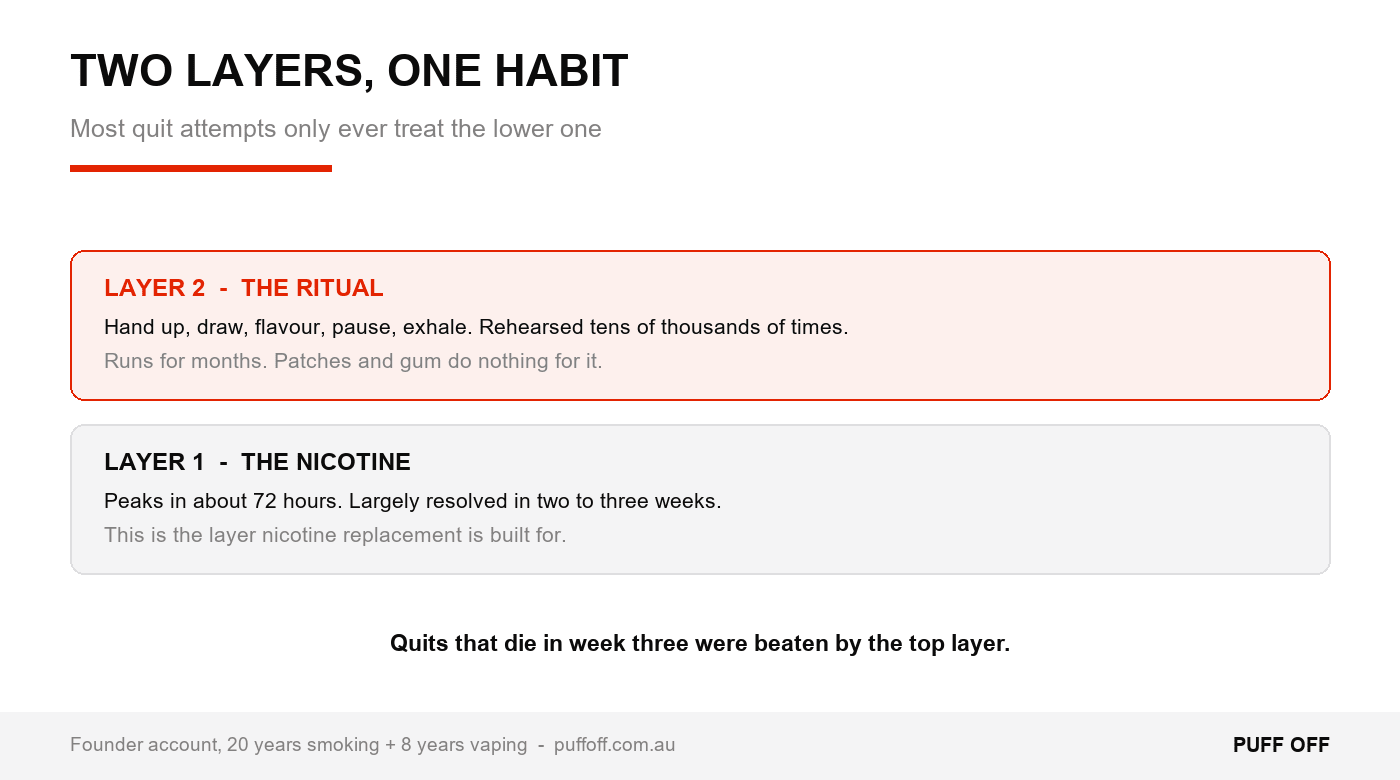
The habit had two layers.
Layer one: nicotine. A chemical dependency with a predictable timeline. Peaks in about 72 hours, largely resolved in two to three weeks. Patches and gum are built for this and they work.
Layer two: the ritual. A physical sequence, rehearsed tens of thousands of times a year until it ran without conscious input. Hand up, draw, flavour, pause, exhale, attached to specific moments in the day.
Every previous attempt had treated layer one and quietly assumed layer two would sort itself out. It never did, because nothing about clearing nicotine from your system teaches your hands to stop reaching.
What actually worked
Three things, in this order.
1. Naming the two layers. Once the problem was two problems, it stopped feeling like a personal failing and started looking like a plan with a gap in it.
2. Planning for day three specifically. Not general resolve. A written decision about what to do when the craving hit, made in advance, while motivation was still high.
3. Giving the reach somewhere to land. Something that completed the sequence rather than interrupting it. Gum covers flavour but not the reach. A stress ball covers hands but not the mouth. What was missing was something that kept the whole motion, without nicotine on the end of it.
That last one is why Puff Off exists. Sam built the thing he could not find: a non-electronic wooden inhaler with food-grade flavour cores, no nicotine, no vapour, no battery. Not a medicine and not a treatment. A replacement for the motion.
What to take from this
If you are on attempt four or five, the useful question is not "how do I try harder." It is "which layer beat me last time."
- Beaten in the first week, feeling physically awful? That is layer one. Talk to a pharmacist about nicotine replacement, and use enough of it.
- Beaten in week three or later, feeling physically fine but restless? That is layer two. More nicotine replacement will not help. You need something for your hands.
- Both? Most people. Use both. They do not conflict.
The full version of Sam's story is on our about page.
FAQ
How long does it take to quit vaping for good?
The chemical part is largely done in two to three weeks. The habit part runs longer, since habit research suggests new automatic behaviours take roughly 66 days on average to form. Most people describe the first week as the hardest by a wide margin.
Why did patches and gum not work for me?
They are built for nicotine withdrawal, so they work on that. If your attempts collapse after week three, when withdrawal has largely passed, the thing beating you is the hand-to-mouth ritual, which nicotine replacement was never designed to address.
Is it harder to quit vaping than smoking?
Many people report the physical withdrawal as milder but the habit as harder. A cigarette has a natural end point, while a vape does not, so the hand-to-mouth motion is repeated far more times per day and is more deeply rehearsed.
Does switching from smoking to vaping help you quit?
It changes the device but not necessarily the loop. Some people use it as a stepping stone successfully. Others, like Sam, find they have simply moved the same routine onto a new object.
What should I do if I have already failed several times?
Work out which layer beat you each time by looking at when the attempt ended. Early collapse points at withdrawal, later collapse points at the ritual. Most repeat attempts fail because the same layer is being treated over and over.
The thing Sam could not find
Built after 28 years of the same reach, for the layer nothing else was covering.
Get the Starter Kit - $12930-day money-back guarantee - if it's not for you, you're covered.